
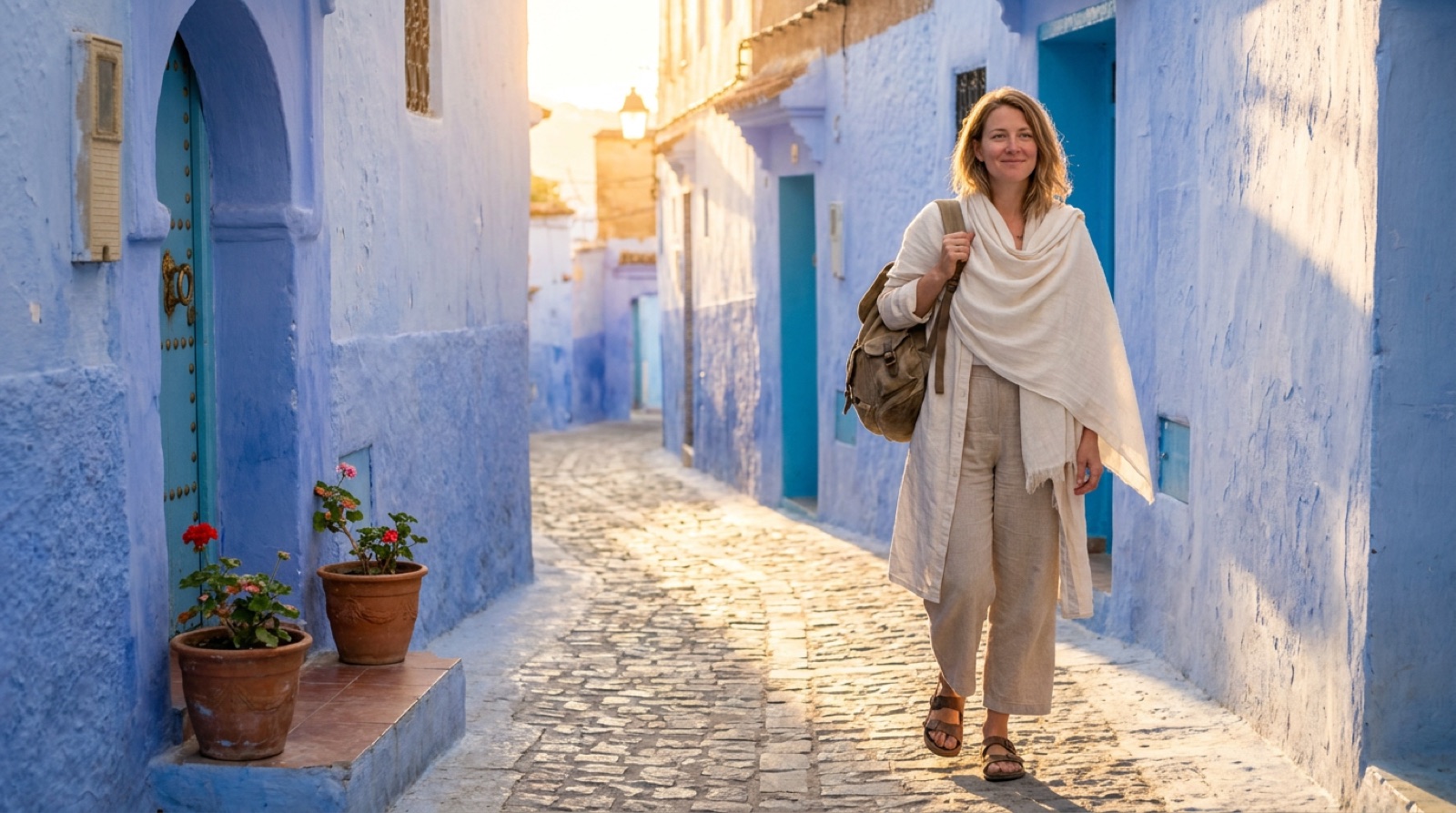
You came here because someone told you Morocco was “amazing” and someone else told you it was “not safe for women.” Both are partly true. This guide is for the solo female traveler who wants the unfiltered version — what to plan for, what to skip, and what the Instagram crowd left out.
Is Morocco safe for women in 2026 — or is the internet exaggerating?
Mostly the latter — but not entirely. The US State Department holds Morocco at Level 2 (exercise increased caution), the UK FCDO issues no advisory against travel to the country, and Morocco logged roughly 14.5 million international arrivals in 2023 per the Ministry of Tourism. That is not a country in crisis. What the advisories don’t capture is the daily verbal layer: a 2017 UN Women / Promundo IMAGES MENA study found 54%+ of Moroccan women report verbal sexual harassment in public spaces, and as a solo foreign woman you’ll absorb some of that too.
“Safe” for a couple means low violent-crime risk. For you, it means that plus a harassment playbook, vetted accommodation, and a transport plan for after dark. Your first 24 hours set the tone — read what to expect at Moroccan airports as a solo arrival before you book the inbound flight.
Is Morocco safe for solo female travellers in the medina at night?
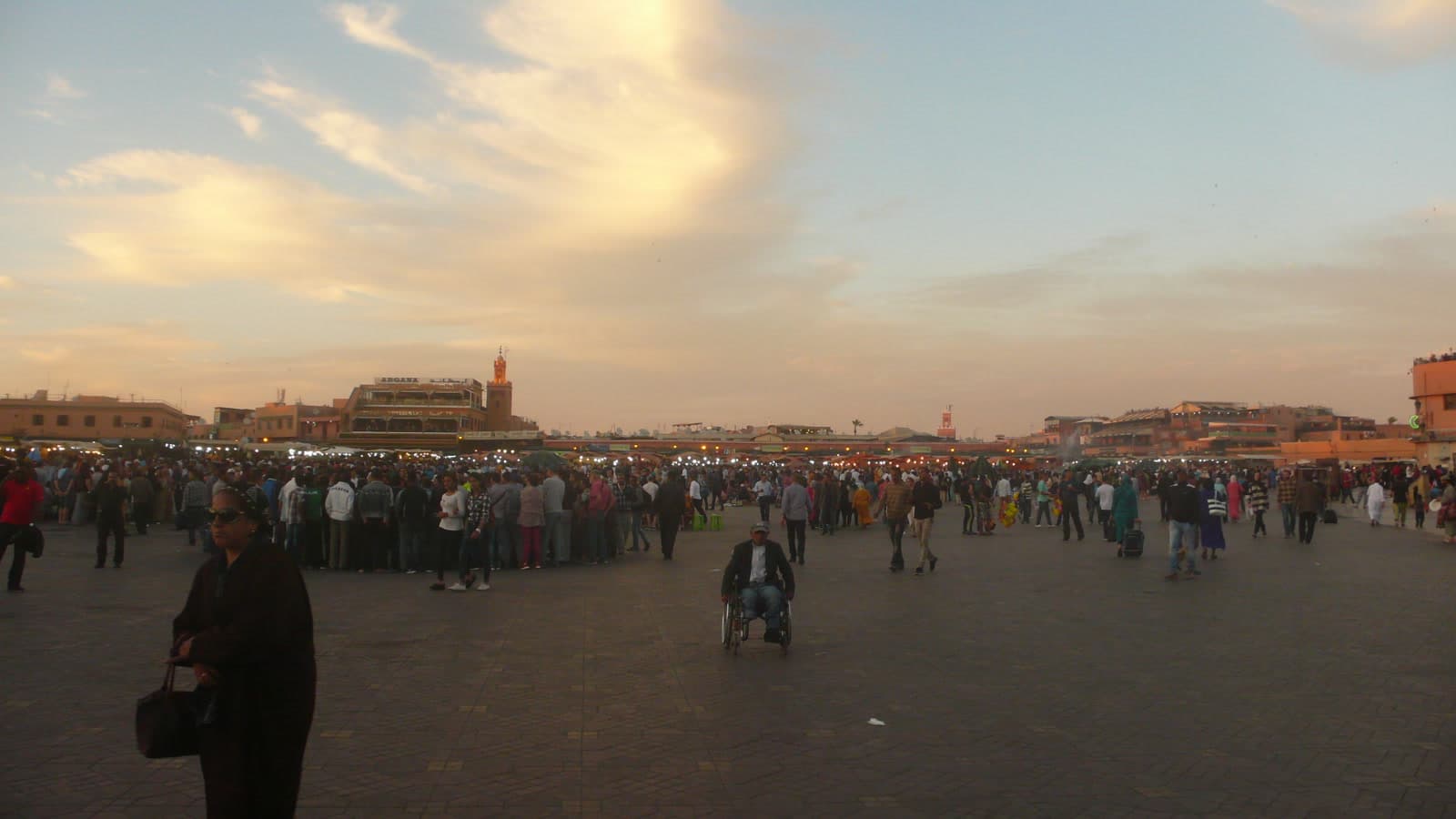
The Medina of Marrakech is a UNESCO World Heritage site (ref. 331, inscribed 1985) with several thousand unmarked alleys — and Google Maps gives up about 40 metres into most of them. After 21:00, stick to the lit arteries near Jemaa el-Fna and skip the derbs off Rue Riad Zitoun el Jdid, the unlit stretch north of Bab Doukkala, and the tangle between Mouassine and Bab Taghzout. Take a petit taxi to the closest bab (gate) to your riad and walk in from there.
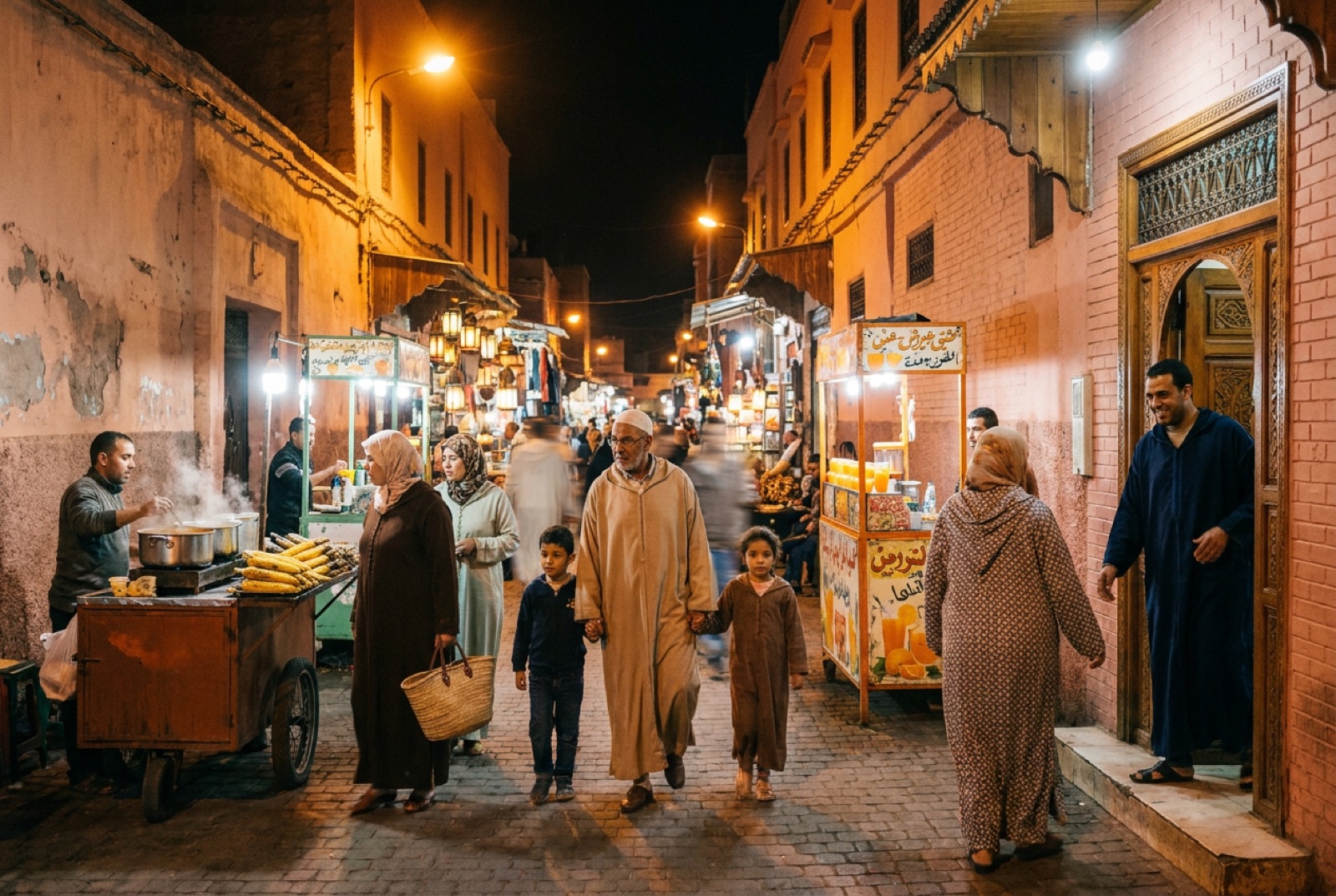
If a man follows you in Fes, do not try to outpace him through the derbs. Step into the next open shop — any shop — and ask the shopkeeper to call you a petit taxi. Dial 19 for police or 112 for the universal mobile line. Memorise key Arabic and Darija phrases every solo woman should memorize before you go.
Are riads actually safe — and what should you check before paying?
Licensed riads with female staff and verifiable locks are among the safest accommodation in Morocco — but “licensed” is doing the heavy lifting in that sentence. A Reddit solo traveler put it bluntly: “People were coming into my room… I had no lock. Scariest travel experience of my life.” Many traditional riads were built with decorative interior latches, not deadbolts, and some unlicensed Airbnbs rely on a master key the male host retains.
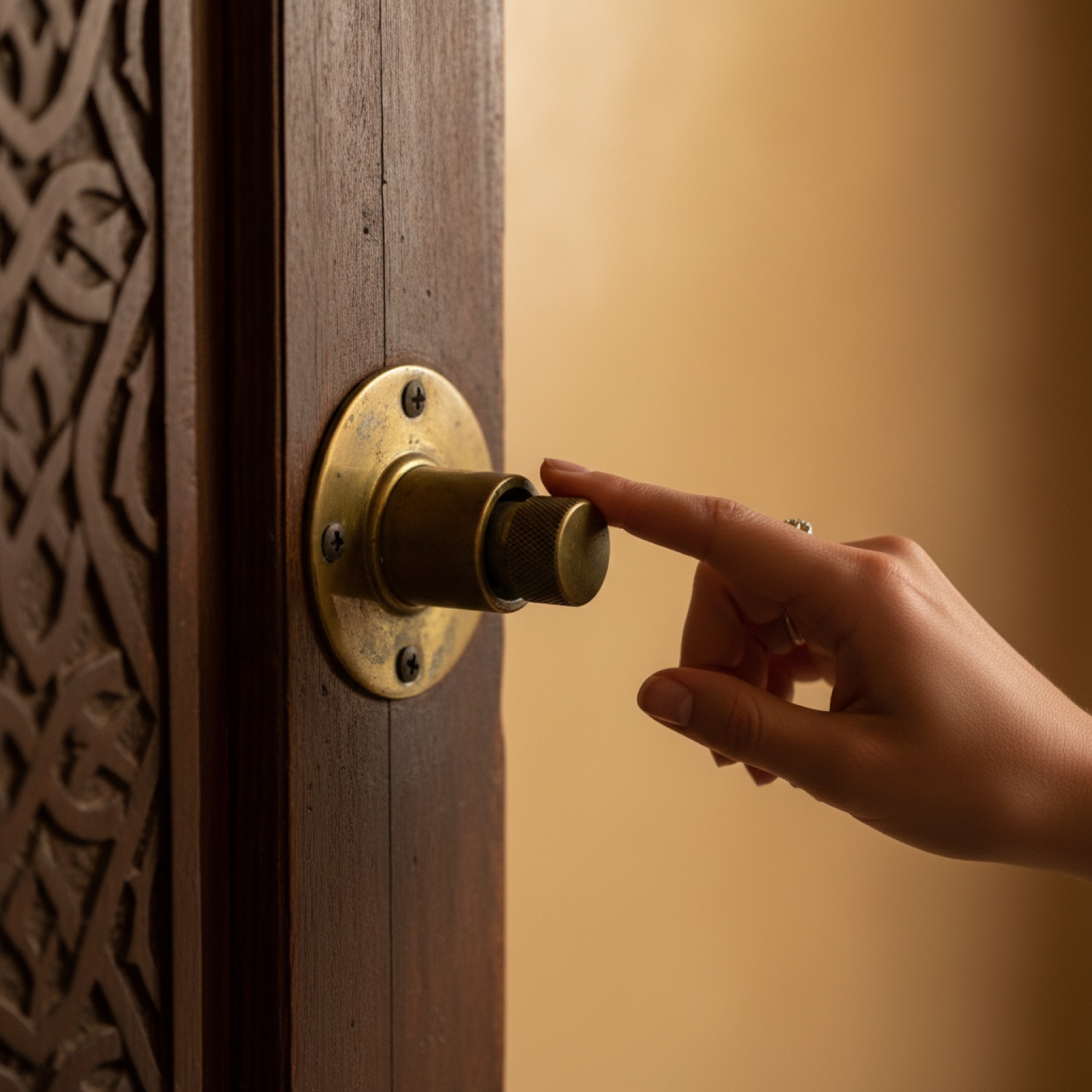
Run this physical check on arrival, before handing over cash: interior bolt that actually resists a shoulder push, exterior front door that locks at night, no master-key override mentioned at check-in. For Airbnb specifically, avoid male-hosted listings in unmarked derbs on your first visit — the “come for tea” and repeated WhatsApp messages flagged by other solo women start there. Report boundary-crossing hosts inside the Airbnb app, not over text.
How do you handle street harassment without escalating it?
Street harassment in Morocco splits into two categories, and they need different responses. Verbal catcalling — kissing sounds, “gazelle,” “where are you from” on loop — gets a verbal answer. A flat “la, shukran” (no, thanks) without eye contact, then keep walking. The shame-based “hshouma” works here, but only in specific conditions.
Use “hshouma” in daylight, with witnesses, on younger men in family neighborhoods. Skip it after dark, in empty alleys, or with anyone intoxicated — it can escalate. Physical brushing in souk crowds needs a physical answer, not words: cross-body bag worn in front, step sideways into the nearest open shop, let the crowd flow past. Memorize key Arabic and Darija phrases every solo woman should memorize before you land — fumbling for them mid-incident burns the moment.
What is the safest way to get around — petit taxi, inDrive, or CTM bus?
Your three real options each leave a different paper trail. Petit taxis are legally required to run the meter (“compteur”) inside city limits per Decree 2-63-260 — if a driver waves you in at a flat rate after dark, refuse and flag the next one. They’re fast and cheap, but there’s no digital record of your ride. inDrive, live in Casablanca, Rabat, Marrakech, Tangier, Agadir, Fes, Meknes, and Tetouan, gives you the driver’s name, plate, and a GPS route you can share with your riad in two taps — worth the extra ten dirhams after 20:00.
For intercity, CTM and Supratours have assigned seating and GPS tracking. Avoid overnight buses that dump you at 04:00 in an empty station — book arrivals after first light and pre-arrange riad pickup.
Is the Sahara Desert safe for solo women on a 3-day tour?
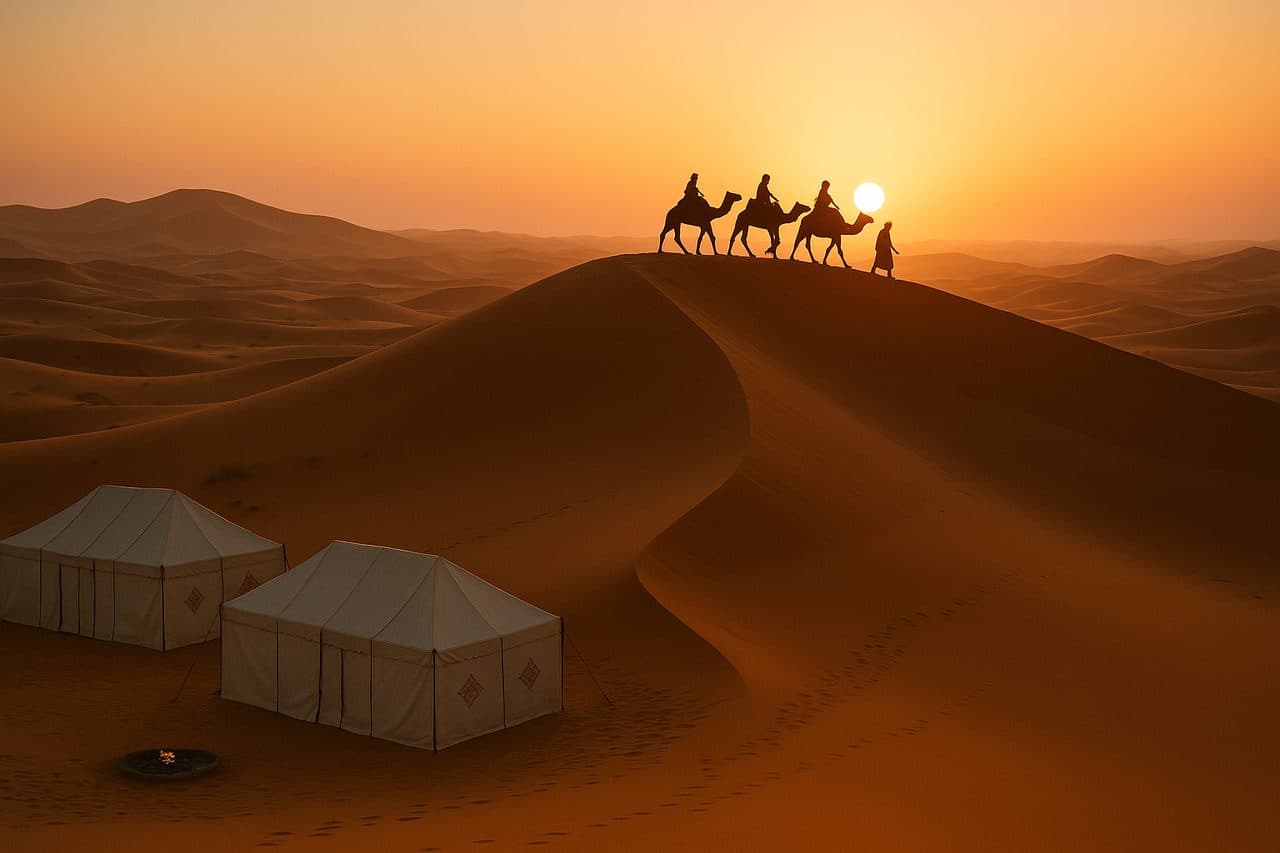
Mostly yes — but a 3-day Merzouga or Zagora trip puts you in a 4×4 with strangers for ten hours, then in a canvas tent with a zipper, not a lock. The risk isn’t the desert; it’s the operator. Vet before you book.
Ask four questions in writing over WhatsApp: How many women are in tomorrow night’s camp? Is there a female staff member on-site overnight? Does my tent have a private interior zipper or padlock loop I can secure? Will you share the camp’s GPS coordinates with my riad before departure? If they dodge any of these, book elsewhere — there are dozens of licensed operators in Merzouga alone.
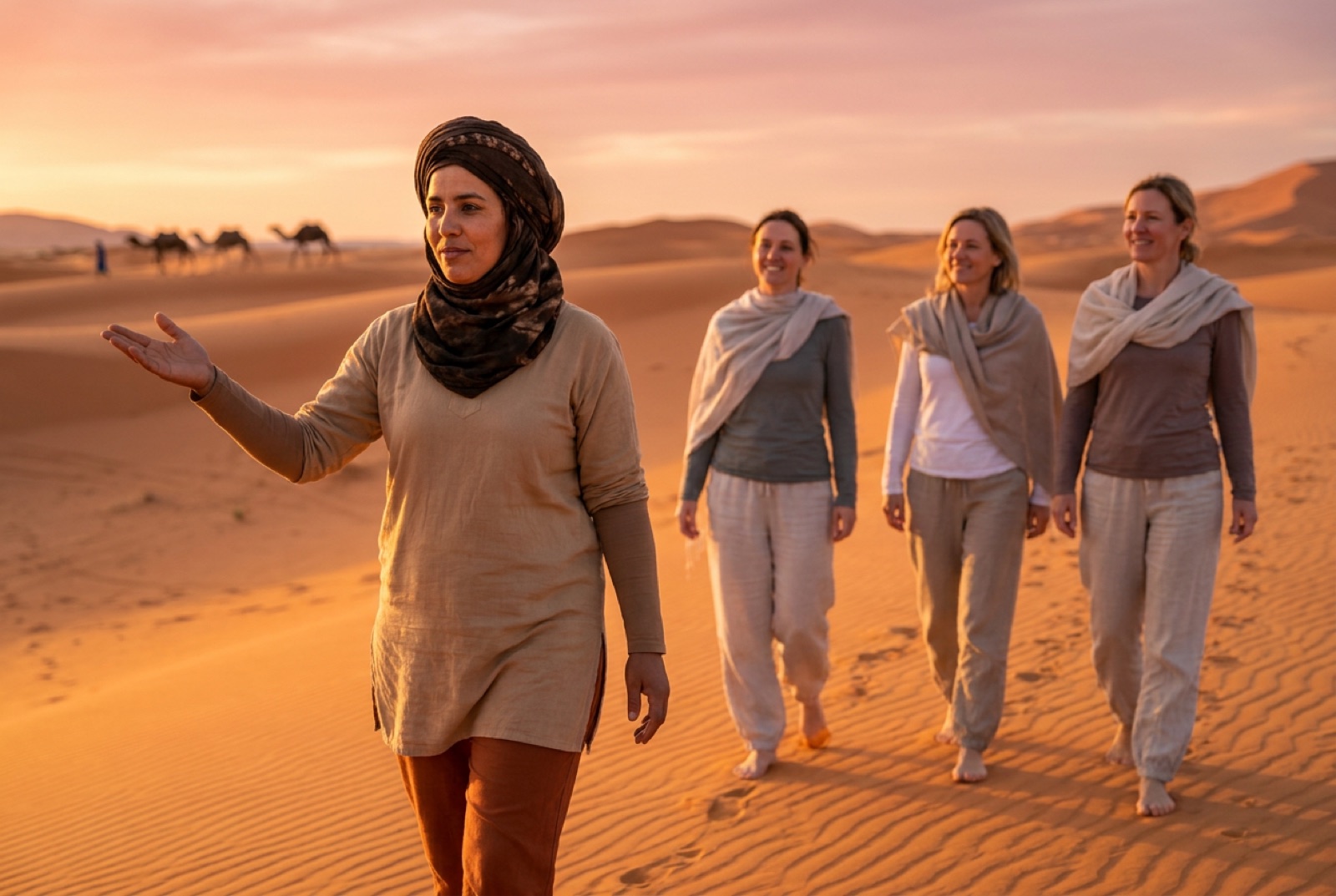
Drop a pin to your riad manager before the convoy leaves Rissani.
What should you wear so you blend in — beyond cover shoulders and knees?
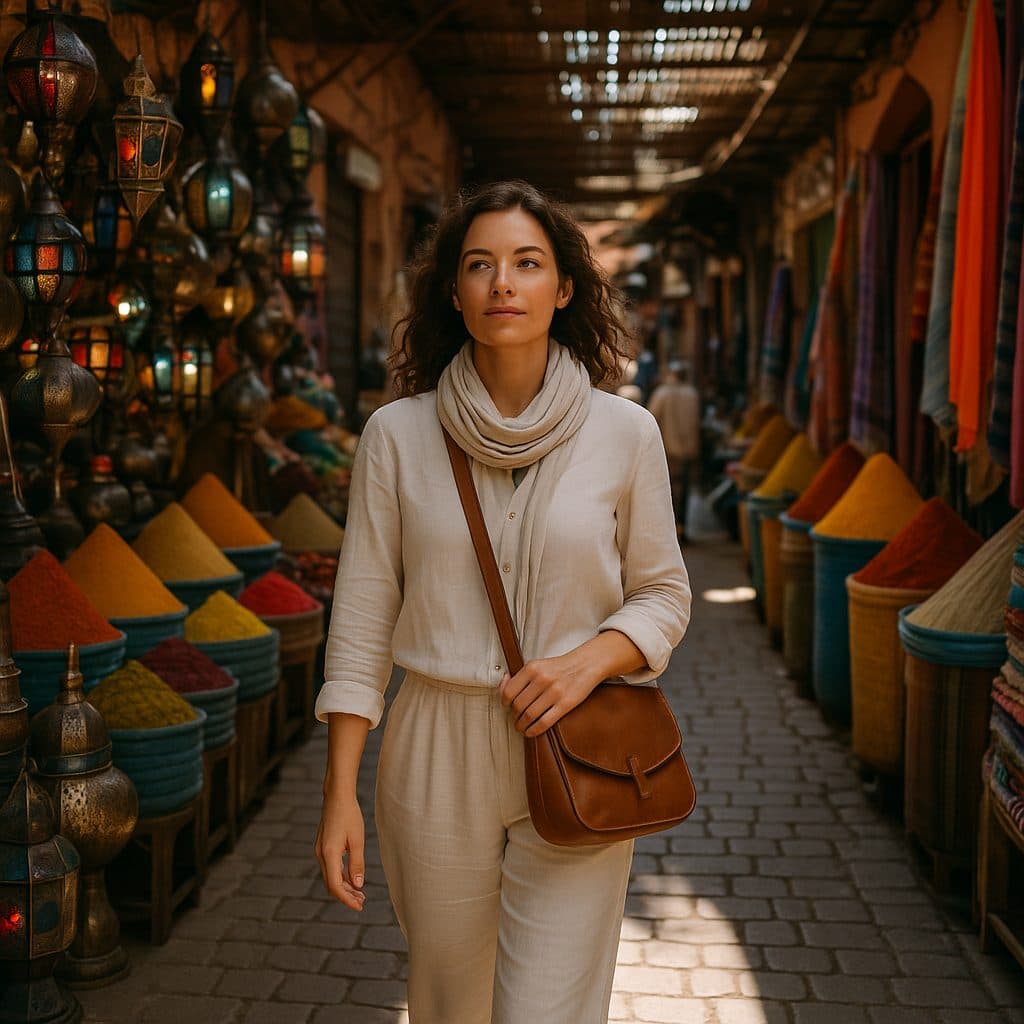
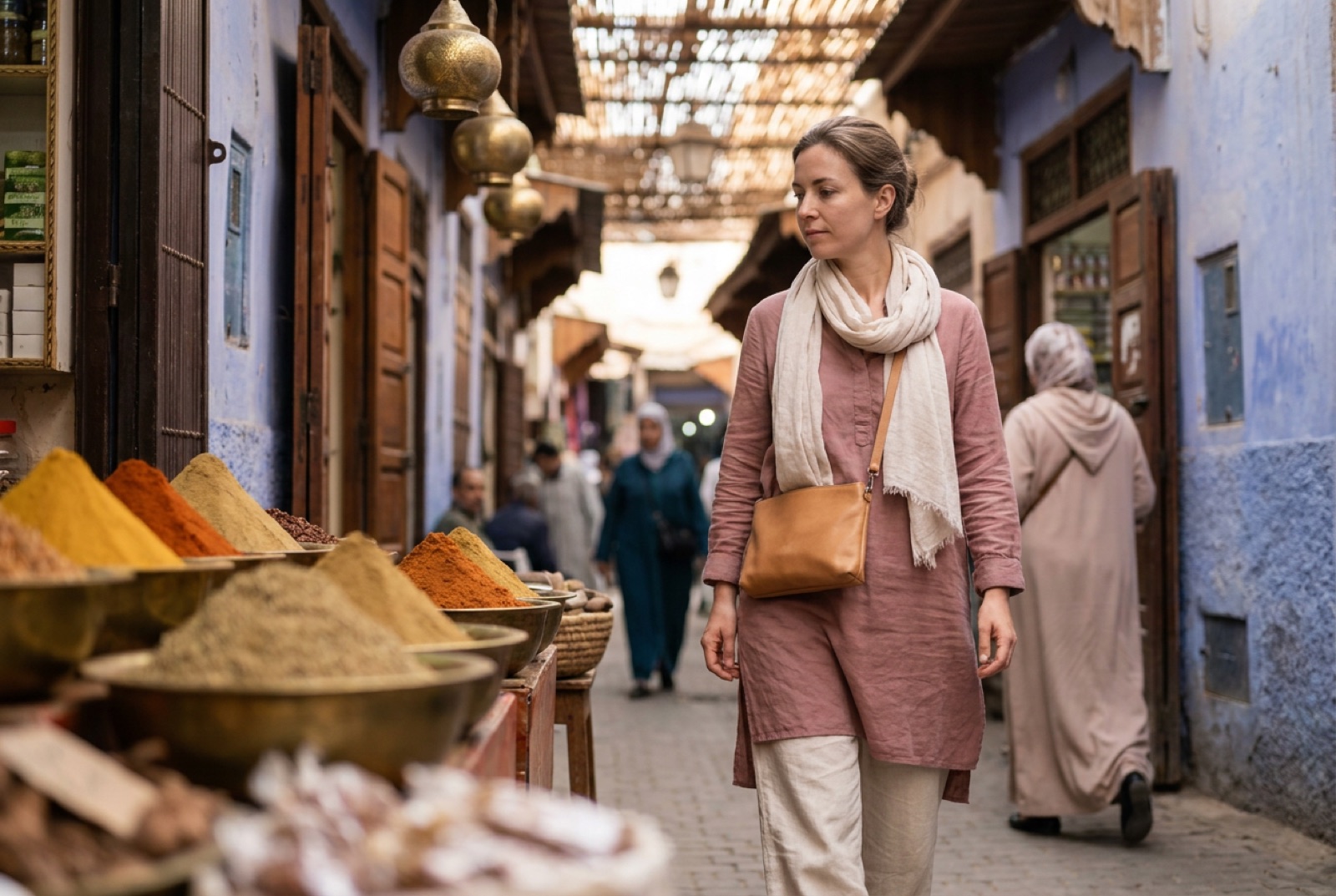
The “shoulders and knees” rule is the floor, not the ceiling. What actually reduces street attention is silhouette, not coverage area. Leggings as standalone bottoms read as underwear to older Moroccans — pair them under a tunic that hits mid-thigh, or skip them for loose linen trousers, wide-leg cotton pants, or a midi skirt that doesn’t cling. A light scarf in your day bag handles mosque exteriors (Hassan II in Casablanca and Koutoubia courtyard in Marrakech expect covered hair at the perimeter).
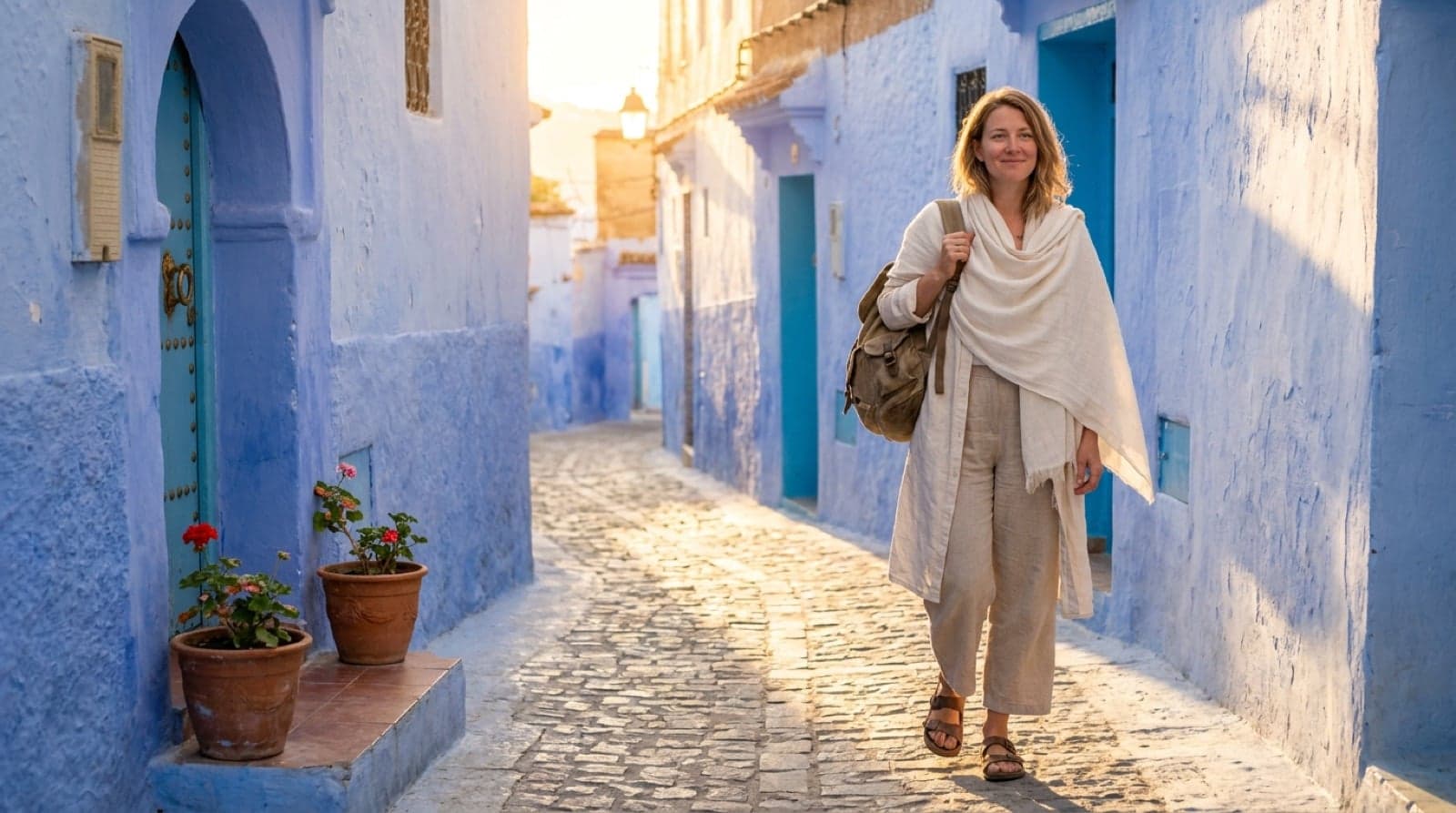
City matters. In Marrakech, local women layer djellabas over jeans — you’ll see everything from full hijab to bare arms on Avenue Mohammed V. Chefchaouen runs more conservative; long sleeves blend better in the blue medina. Essaouira’s coastal wind tolerates sundresses with a cardigan. For the full playbook, see how to dress respectfully without erasing yourself.
What do you do if something actually goes wrong — and which numbers do you call?
Save these in your phone before you land, not when your hands are shaking. Police: 19. Gendarmerie Royale (for rural roads, highways, outside city limits): 177. SAMU medical urgency: 15 in urban centers, 150 for regional/Casablanca. Civil Protection and fire: 15. Universal mobile emergency that works on every Moroccan network: 112.
For tourist-specific incidents, the Brigade Touristique has multilingual officers stationed in Marrakech (off Jemaa el-Fna), Fes (near Bab Boujloud), Casablanca, Tangier, and Agadir. They handle theft, harassment, and scam reports with English and French support.
If you experience sexual harassment, Article 503-1-1 of the Penal Code (Law 103-13, 2018) criminalizes it in public spaces with 1–6 months imprisonment and 2,000–10,000 MAD fines. File at the nearest police station or Brigade Touristique post. Call your embassy in parallel.
How do you manage the mental toll of constant attention?
Two weeks of “bonjour gazelle” and souk-crowd brushing wears down even seasoned travelers. The fatigue is real, it’s cumulative, and it’s the part nobody puts on Instagram. The UN Women IMAGES MENA study found over 54% of Moroccan women themselves report verbal sexual harassment in public — so you’re not imagining it, and you’re not weak for feeling drained by it.
Build her ratio into your itinerary: one full riad day per three active days. Eat slowly on those days — see how to plan your riad-day food rhythm for the breakfast-to-mint-tea cadence that actually restores you.
Book a women-only hammam session (Hammam de la Rose in Marrakech, or any neighborhood hammam during women-only hours, typically 09:00–17:00). Hire a female ONMT-licensed guide for half-day medina walks. The harassment doesn’t stop — but your buffer against it gets thicker.
Where can you go if you want a softer landing your first three days in Morocco?
Start where the volume is lower and the eye contact is gentler. Chefchaouen and Essaouira consistently rank among the lowest-harassment destinations for solo women per ONMT regional visitor-experience surveys, and Essaouira’s official tourism office positions the city as a “destination familiale et apaisée.” Chefchaouen’s blue medina is small enough to learn in an afternoon, and Essaouira’s Atlantic wind keeps the souks cooler and the pace slower than Marrakech or Fes. Land in Casablanca or Tangier, take a CTM bus to Chefchaouen for two nights, then loop down to Essaouira before facing the bigger imperial cities. To map the order of your stops, compare Morocco itineraries by trip length.
Time it with the best months for solo travel in Morocco — shoulder seasons keep crowds, heat, and harassment baseline lower.
Frequently Asked Questions
- Is Morocco safe for women travelling alone?
- Morocco is rated Level 2 (exercise increased caution) by the US State Department and carries no UK FCDO advisory against travel. Violent crime against tourists is rare, but verbal harassment of solo women is common in major cities. Most solo female travelers complete trips without incident by using licensed taxis or inDrive, returning to riads before 21:00, and choosing accommodation with verifiable physical locks.
- What should I do if a man starts following me in the medina?
- Walk into the nearest open shop — any shop. Tell the shopkeeper “rajul yataba’uni” (a man is following me) or simply “help, please” in English. Ask them to call you a petit taxi or escort you to the nearest riad. Dial 19 for police or 112 for the universal mobile emergency line if the situation escalates further.
- Are riads safe for solo female travelers?
- Licensed riads with female staff and verifiable exterior locks are generally very safe. Before paying, check that your room has a functioning interior bolt (not just a decorative latch), confirm the front door is locked at night, and read recent reviews specifically from solo women. Avoid male-hosted Airbnbs in remote, unmarked medina locations on your first visit to Morocco.
- Can I wear leggings or shorts in Morocco?
- You legally can, but practically you’ll attract significantly more unwanted attention. Loose linen trousers, midi skirts, and tunics that cover the hips are the sweet spot — cool in heat, modest enough to blend in. Reserve shorts for beach towns like Essaouira and Agadir, and skip leggings as standalone bottoms (they read as underwear to older Moroccans).
Citations
- US State Department — Morocco Travel Advisory (Level 2)
- UK FCDO — Morocco Travel Advice
- Moroccan Ministry of Tourism — 2023 Arrivals Statistics
- UN Women / Promundo — IMAGES MENA Morocco Report (2017)
- UNESCO World Heritage — Medina of Marrakech (Ref. 331)
- Morocco Penal Code — Law 103-13 Article 503-1-1 (Sexual Harassment, 2018)
- Office National Marocain du Tourisme (ONMT) — Visit Morocco Official
- Brigade Touristique — Direction Générale de la Sûreté Nationale