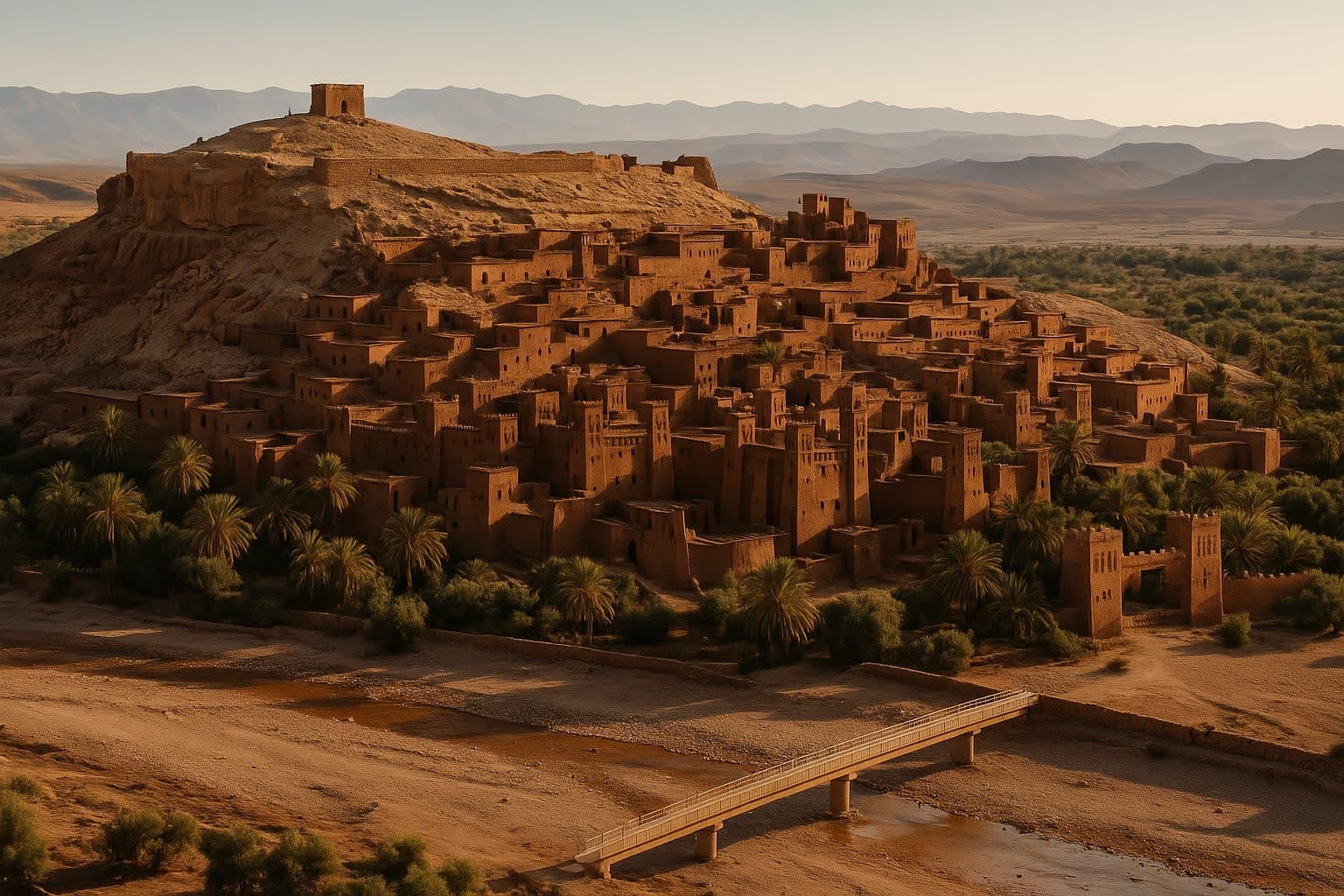

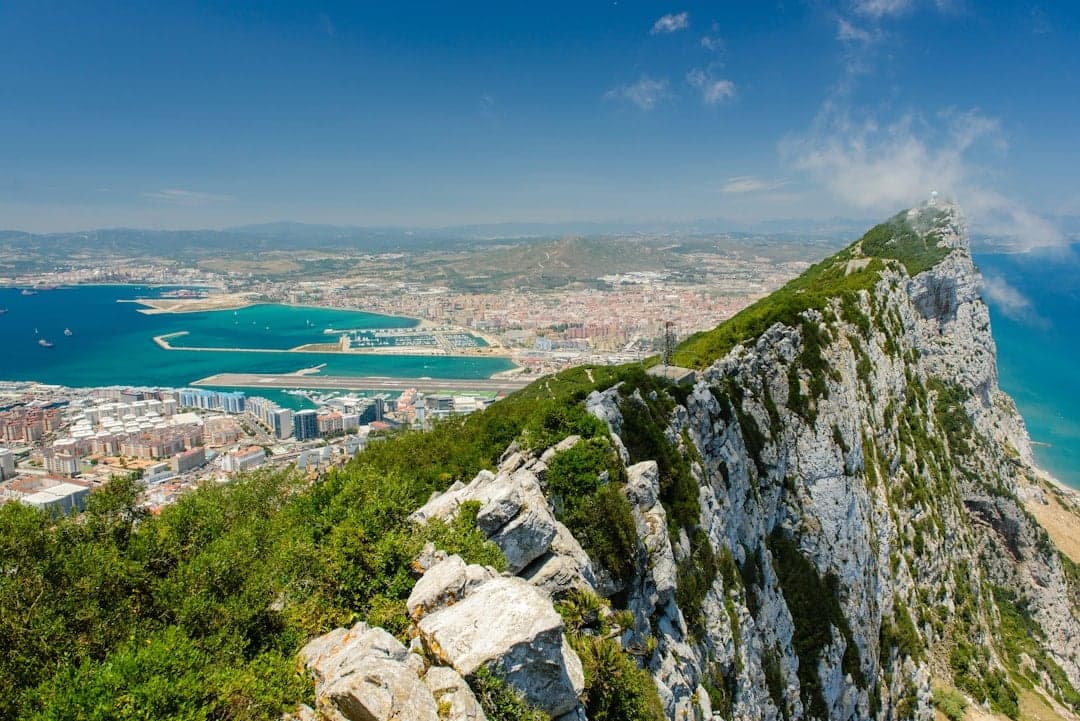
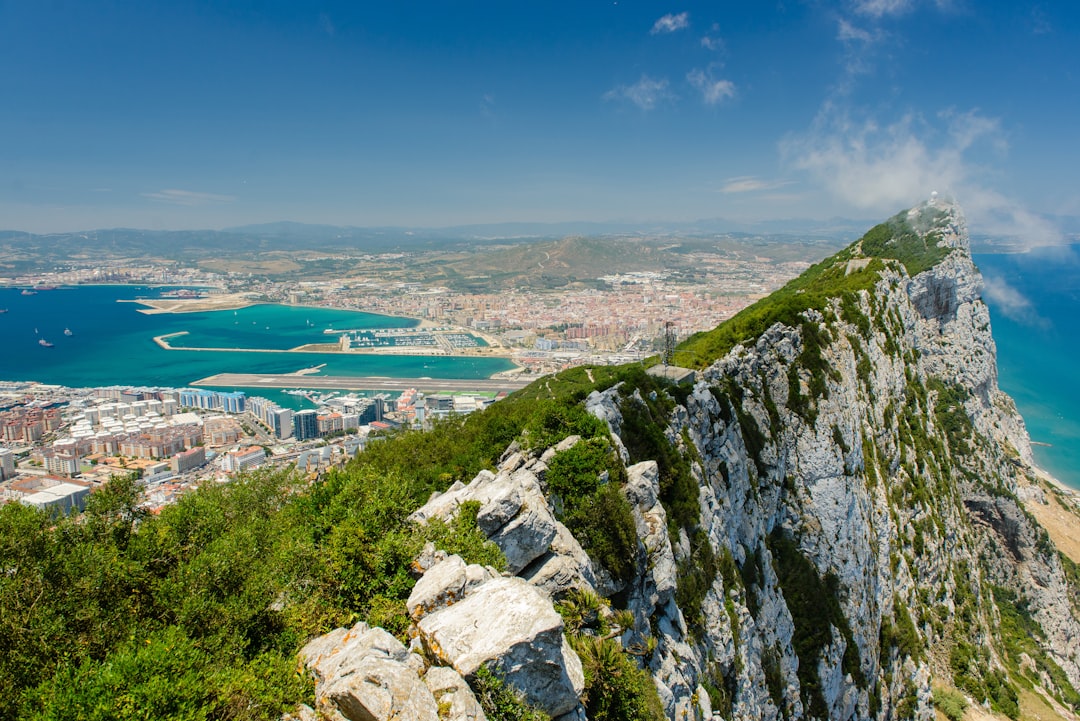
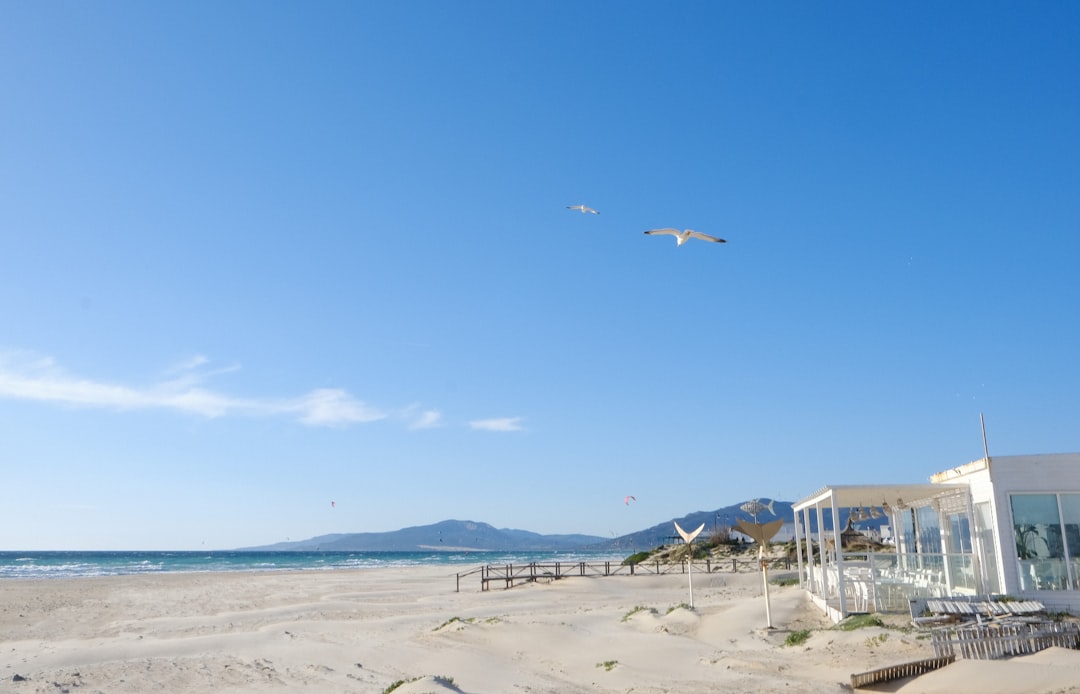
If you’re standing on a Spanish beach near Tarifa and looking south, the brown ridge on the horizon is the Rif Mountains in Morocco — 14 km away at the narrowest point of the Strait of Gibraltar. The two countries are closer than London and Brighton. Yet most first-time travellers from Spain to Morocco approach the logistics like it’s a trans-continental odyssey. This guide is the framework I give every guest crossing the strait: which ferry to take, when to fly instead, how the day-trip-from-Tarifa actually works, and the small details (Tanger Med vs Tangier Ville, FRS vs Balearia, time zone, currency) that nobody tells you upfront.
How far is Morocco from Spain?
The shortest distance between Spain and Morocco is about 14 km / 8.7 miles, measured between Punta de Tarifa on the Spanish coast and Punta Cires on the Moroccan side. That’s the narrowest point of the Strait of Gibraltar — the body of water that connects the Mediterranean Sea to the Atlantic Ocean and separates Europe from Africa. On a clear morning, the Moroccan coast is visible from the Mirador del Estrecho viewpoint, ~7 km east of Tarifa on the N-340 highway.
Distances stretch quickly from the strait. Algeciras to Tangier Med port is about 28 km of open water (1h30 ferry). Malaga to Melilla is 240 km (overnight ferry, ~8h). Barcelona to Tangier Med is 1,070 km by sea (24–30h on Grimaldi Lines’ weekly long-haul). Distance, not visa, is what shapes which crossing makes sense for you.
The 5 ferry routes from Spain to Morocco
Five sea routes connect Spanish ports to Morocco. Pick by where you are in Spain, whether you’re driving, and whether you want to land in the city centre or near it.
| Route | Crossing time | Operators | Walk-on (~€) | Car (~€) | Frequency |
|---|---|---|---|---|---|
| Tarifa → Tangier Ville | 1 h | FRS, Inter Shipping | 37 | n/a (no cars) | 8–10/day summer · 5–6/day winter |
| Algeciras → Tangier Med | 1 h 30 | FRS, Balearia, AML, Inter Shipping | 32 | 100–180 | 12+/day year-round |
| Algeciras → Ceuta | 1 h | FRS, Balearia | 30 | 90–150 | 8–10/day |
| Malaga → Melilla | 8 h (overnight) | Trasmediterránea (Naviera Armas) | 45 | 130–200 | 4–5/week |
| Almería → Nador | 8 h (overnight) | Trasmediterránea, AML | 45 | 130–200 | 4–6/week |
| Barcelona → Tangier Med | 24–30 h | Grimaldi Lines | 80 | 200–350 | 1/week |
The single most-confused booking detail: Tangier Ville (the city port, walkable to the medina) and Tangier Med (the modern car-ferry terminal 45 km east, near Ksar es-Seghir) are different ports. If you book Algeciras → Tangier Med expecting to be in the medina, you’ll get an unwelcome 45-km taxi ride (~€40, 45 min) on arrival. Tarifa → Tangier Ville is the only direct route into the city centre, and that’s why it sells out first in summer.
Tarifa → Tangier Ville — the fast walking route
The Tarifa–Tangier Ville fast ferry is the single best Spain-to-Morocco crossing for foot passengers, and it’s the route I tell every guest to take if they have the option. FRS (Ferries Rapidos del Sur) and Inter Shipping run high-speed catamarans on a 1-hour crossing, with 8–10 daily departures in summer and 5–6 in winter. Walk-on fares start around €37 one-way.
Why this matters: the boat docks in Tangier Ville port, a 10-minute walk from the medina, the Petit Socco café terraces, and the Tangier kasbah. No transfer. Step off the ferry, walk uphill, you’re in Morocco. The same crossing from Algeciras lands you at Tanger Med, 45 km out of town.
No cars on this route. Foot passengers and bicycles only.
Algeciras → Tangier Med — the car-and-truck workhorse
If you’re bringing a car (read the rental warning below), you’ll use Algeciras → Tangier Med. The crossing is ~1h30, and operators include FRS, Balearia, AML (Africa Morocco Link), and Inter Shipping. Departures run 12+ times per day, year-round, with car-and-driver fares from ~€100 for a small vehicle plus driver. Walk-on passengers are accepted from ~€32.
Tanger Med itself is one of Africa’s largest container ports and the main maritime gateway for goods entering Morocco. The passenger terminal is well-organized but the port is outside Tangier — a taxi to the city centre runs ~€40 / 400 MAD, or you can catch the CTM shuttle bus (~€5 / 50 MAD, 50 minutes).
Algeciras → Ceuta — the Spain-only crossing
The Algeciras → Ceuta route runs FRS and Balearia ferries in about 1 hour, walk-on from ~€30. Important: Ceuta is Spanish territory, not Moroccan. You arrive on Spanish soil, then walk or drive 3 km south to the Bab Sebta land border to enter Morocco. The border is open to road traffic and pedestrians but queues can be slow (1–2h at peak times). This route makes sense if you’re heading specifically for Tetouan or Chefchaouen (Bab Sebta is ~45 km from Tetouan) and want to avoid the Tangier scrum.
Malaga → Melilla and Almería → Nador — the overnight options
Malaga → Melilla and Almería → Nador are 8-hour overnight crossings run by Trasmediterránea (part of the Naviera Armas group) and AML. Cabin fares from ~€45 walk-on. These are the right choices if you’re starting from eastern Andalusia and heading for eastern Morocco (Nador, Saidia, Oujda, the Rif). Like Ceuta, Melilla is Spanish territory; you cross the land border at Beni Ensar to enter Morocco proper.
Barcelona → Tangier Med — the long-haul option
Grimaldi Lines runs a weekly Barcelona–Tangier Med sailing, 24–30 hours, walk-on from ~€80, car from ~€200. This is the route to consider if you’re already in Catalonia and don’t want to drive 1,000 km to Algeciras first. The ship has cabins, a restaurant, and a pool deck — closer to a small cruise than to a ferry.
How long is the ferry from Spain to Morocco?
The fastest crossing is Tarifa → Tangier Ville at 1 hour. The most-used crossing is Algeciras → Tangier Med at 1h30. The shortest land-departure-to-Morocco-on-foot is still Tarifa: at high-season tempo, you can walk off your Sevilla bus at Tarifa port, board the FRS catamaran 20 minutes later, and be drinking mint tea in the Petit Socco within 2.5 hours of leaving Spain.
| Route | Crossing time | Realistic door-to-door (port to medina) |
|---|---|---|
| Tarifa → Tangier Ville | 1 h | 1h 30 (10-min walk on arrival) |
| Algeciras → Tangier Med | 1h 30 | 2h 45 (45-km transfer required) |
| Algeciras → Ceuta + Bab Sebta | 1 h + 1–2h border | 4 h to Tetouan, ~5h to Chefchaouen |
| Malaga → Melilla + Beni Ensar | 8 h + 30-min border | 9 h to Nador, ~10 h to Saidia |
| Almería → Nador | 8 h | 8 h 30 to Nador city |
| Barcelona → Tangier Med | 24–30 h | 26 h+ to Tangier centre |
Frequencies dip 10–15% during Ramadan (2026: Feb 17 – Mar 19; 2027 will start around Feb 6) as crew rotation shifts. Book ahead if travelling then. See our Morocco during Ramadan guide for the broader implications.
Ferry operators compared — FRS, Balearia, Inter Shipping, AML, Trasmediterránea
Five operators cover the Spain–Morocco market. The realistic differences are about reliability, on-board comfort, and which route they run — not headline price.
- FRS (Ferries Rapidos del Sur) runs Tarifa–Tangier Ville, Algeciras–Tangier Med, and Algeciras–Ceuta. The most-booked operator by tourists; high-frequency, clean catamarans, app-based ticketing. The
frs ferry spain to moroccois the keyword variant travellers use to find them directly. - Balearia runs Algeciras–Tangier Med and Algeciras–Ceuta. Slightly larger vessels, slower turnaround, popular for car travel.
- Inter Shipping runs Tarifa–Tangier Ville as a budget alternative to FRS. Same crossing, similar timing, ~10% cheaper.
- AML (Africa Morocco Link) is the Moroccan-flag operator on Algeciras–Tangier Med and Almería–Nador. Solid for cars.
- Trasmediterránea (part of Naviera Armas) is the Spanish national-historical operator. Runs the Malaga–Melilla and Almería–Nador overnight routes.
For a same-day Tarifa walk-on, my default is FRS — fastest app booking, most predictable schedule, and the high-speed catamarans have outdoor decks. For a car going to Tangier Med, the choice is whoever has space on your dates — book through Direct Ferries or an aggregator to compare in one screen.
Flying from Spain to Morocco — when it makes sense
If you’re already in southern Spain (Andalusia, Costa del Sol, Murcia), the ferry beats flying on every metric: price, total door-to-door time, scenery. Don’t fly Malaga–Marrakech if you can drive 2 hours to Algeciras and ferry across.
Flying makes sense in three specific cases:
- Madrid or Barcelona → deep-Morocco. If you’re north of Valencia and your end-destination is Marrakech, Fes, or Casablanca — not Tangier — the Madrid–Marrakech direct (Royal Air Maroc, Iberia, Ryanair, ~3 hours) saves a full day vs ferry + internal transfer.
- Tight schedules. Weekend trips don’t have time for an 8-hour overnight ferry plus border processing.
- You’re connecting onward. Casablanca (CMN) is Royal Air Maroc’s hub for sub-Saharan Africa and North America — useful if Morocco is a leg of a longer trip.
Direct flight pairings that exist year-round (2026):
- Madrid (MAD) → Casablanca (CMN) — Iberia, Royal Air Maroc, Ryanair · ~3h
- Madrid (MAD) → Marrakech (RAK) — Iberia, Royal Air Maroc, Ryanair · ~3h
- Barcelona (BCN) → Tangier (TNG) — Vueling, Ryanair · ~2h
- Barcelona (BCN) → Casablanca (CMN) — Royal Air Maroc · ~2h30
- Seville (SVQ) → Tangier (TNG) — limited; check seasonal
- Malaga (AGP) → Tangier (TNG) — Ryanair, seasonal
For broader context on which Moroccan airport to land in, see our Morocco airports & flights guide.
Day trip to Morocco from Spain — how it actually works
A day trip to Morocco from Spain is the most asked-about logistical setup in the Spain → Morocco cluster, and it works — provided you set realistic expectations. You will not “see Morocco” in a day. You’ll see Tangier.
The standard setup is Tarifa → Tangier Ville → guided half-day in Tangier → ferry back. Most major operators (FRS, We Love Tangier, Get Your Guide aggregators) package it as a single ticket: ferry + guided tour + lunch + return ferry, €60–90 per person, total elapsed time 9–10 hours from Tarifa port back to Tarifa port. Pickups also run from Tarifa, Algeciras, Malaga, Marbella, and Seville with hotel transfer included for ~€20–30 extra.
A typical itinerary:
- 08:00 depart Tarifa on the FRS catamaran
- 09:00 dock at Tangier Ville port; meet your guide
- 09:30 Tangier kasbah walking tour, including American Legation museum and the Petit Socco
- 12:30 lunch (couscous or tagine, included)
- 14:30 medina free time
- 16:00 souvenirs and tea stop
- 17:30 ferry back to Tarifa
- 18:30 disembark in Spain
The KD-0 unicorn spain to morocco day trip is the exact query travellers use; the KD-3 phrase day trips to morocco from spain is the same intent. The KD-4 phrase day trips from malaga spain to morocco is the Malaga-pickup variant.
If you want a longer first taste of Morocco than 8 hours, take the Tarifa ferry one-way on Day 1, sleep in a Tangier riad, and either spend a second day in the city or take the Al Boraq high-speed train to Casablanca, Rabat, or Fes (2h to 2h10 from Tangier, ~€20–25). For routing options once you’re across, see Morocco’s most beautiful spots and our Morocco itinerary planner.
Driving + car-on-ferry — what to know
This is where most travellers get unwelcome surprises.
Virtually every Spanish car-rental contract forbids taking the rental vehicle to Morocco. Hertz, Europcar, Avis, Sixt, Goldcar — all of them. Driving a Spanish rental onto a Tangier Med ferry without written authorisation typically voids your insurance the moment the wheels leave the boat, and the rental company can charge a punitive recovery fee if the car is detained at the border.
If you must drive your own (not rental) car or motorcycle across:
- The Algeciras → Tangier Med route is the standard choice. Book with FRS, Balearia, or AML.
- You’ll need: vehicle registration document (V5 or equivalent), driver’s licence (IDP recommended), and Moroccan green-card insurance (“carte verte”) — buy at the port or via Wafa Assurance for ~€60–100 per week.
- A D16ter declaration must be filed at the border to temporarily import the vehicle into Morocco. The form is handed out at the port and processed on arrival.
- Maximum stay for the vehicle = your visitor visa exemption (usually 90 days for visa-exempt nationals; the vehicle MUST leave when you do or you face seizure).
- Driving rules in Morocco itself are covered in our Driving in Morocco guide.
For most travellers, the practical answer is: leave the rental car in Spain, ferry across as a foot passenger, and hire a local driver or rent a Moroccan car from Tangier Avis / Sixt / local agencies once you’re across. Cheaper, safer, no border-crossing paperwork.
Which Spanish city to depart from?
Match your starting point to the right ferry port:
- From Tarifa: walk to the port; take the FRS or Inter Shipping fast ferry to Tangier Ville (1h).
- From Algeciras: 30-minute drive from Tarifa or hourly bus from Seville (~3h, ~€18). Take FRS / Balearia / AML to Tangier Med or Ceuta.
- From Malaga / Costa del Sol / Marbella: drive to Algeciras (1h–1h30) and ferry across; or take the overnight Trasmediterránea to Melilla.
- From Seville: bus or train to Algeciras (~3h); ALSA runs direct buses to Tarifa as well. Seville–Tangier flights exist but are seasonal.
- From Granada: drive to Algeciras (~3h) or take the overnight from Almería (2h drive). Granada–Tangier flights are limited.
- From Madrid: fly Iberia or Royal Air Maroc direct to Casablanca / Marrakech (~3h). Or train to Algeciras (~5h on AVE + Cercanías) for the ferry.
- From Barcelona: fly Vueling / Ryanair to Tangier or Casablanca (~2h), or take the weekly Grimaldi Lines long-haul ferry to Tangier Med (24–30h).
Ceuta, Melilla and the land borders
Two Spanish autonomous cities sit on the North African coast: Ceuta (across from Algeciras, on the Strait of Gibraltar) and Melilla (across from Almería, further east on the Mediterranean). Spain administers both as integral Spanish territory under the same constitutional framework as mainland regions; for travellers, the practical question is just border logistics.
To enter Morocco from either city you cross a land border:
- Bab Sebta (Ceuta side) — open to road traffic and pedestrians, 24h most days. Queue times 30 min to 2h depending on time of day; mornings are faster. Once across, you’re 45 km from Tetouan and ~90 km from Chefchaouen.
- Beni Ensar (Melilla side) — similar setup; 15 km from Nador.
Both are real border crossings: bring your passport, get an entry stamp, declare cash > €10,000. The Moroccan customs (Douane) can search luggage; this is routine, not adversarial. Stay polite, answer questions plainly. For broader safety context in Morocco itself, see Is Morocco safe?.
Recommended action — which crossing to pick
Quick decision tree:
- In Andalusia, walking, going to Tangier or beyond? → Tarifa → Tangier Ville, FRS or Inter Shipping. The 1-hour catamaran, foot-passenger only, lands you in the medina.
- Driving (your own car) and going anywhere in Morocco? → Algeciras → Tangier Med, FRS / Balearia / AML. The car-and-truck workhorse.
- Heading specifically for Tetouan or Chefchaouen and don’t want the Tangier scrum? → Algeciras → Ceuta + Bab Sebta border. Adds ~2h vs Tangier Med but you skip Tangier entirely.
- In eastern Andalusia (Malaga, Granada, Almería) and heading to eastern Morocco (Nador, Saidia)? → Overnight Malaga → Melilla or Almería → Nador, Trasmediterránea.
- In Madrid, Barcelona, or northern Spain, with a tight schedule? → Fly direct. Madrid/Barcelona to Casablanca, Marrakech, or Tangier.
- In Spain for a day and want a quick Morocco taste? → Tarifa day-trip package, €60–90 all-in, back the same evening.
If any of that gets complicated for your specific dates and group, that’s exactly what we do for guests — GuideMe builds custom Spain-to-Morocco crossings with ferry tickets, a Tangier riad night, and onward private driver, all booked under one WhatsApp contact.
Frequently asked questions
How long is the ferry from Spain to Morocco?
The fastest crossing is the Tarifa to Tangier Ville fast ferry — 1 hour, run by FRS and Inter Shipping. The Algeciras to Tangier Med car ferry is 1h30. Algeciras to Ceuta is 1 hour but adds a land-border crossing to enter Morocco proper. Overnight routes from Malaga to Melilla and Almería to Nador run ~8 hours. The Barcelona to Tangier Med long-haul takes 24 to 30 hours.
How much is the ferry from Spain to Morocco?
Walk-on fares start around €37 one-way for Tarifa to Tangier Ville, €32 for Algeciras to Tangier Med, and €30 for Algeciras to Ceuta. Adding a car costs an additional €70–150 depending on the route and vehicle size. Overnight routes from Malaga and Almería start around €45 walk-on. Prices fluctuate weekly — book through FRS, Balearia, or an aggregator like Direct Ferries for current fares.
Can you drive from Spain to Morocco?
You cannot drive a continuous road — there is no bridge or tunnel — but you can drive your car onto a ferry, most commonly Algeciras → Tangier Med (1h30 crossing). Most Spanish rental cars are contractually forbidden from entering Morocco, so this is realistic only for owned vehicles or rentals with explicit cross-border permission. You’ll need vehicle registration, Moroccan green-card insurance, and a D16ter customs declaration at the border.
Is there a bridge or tunnel from Spain to Morocco?
No. The Strait of Gibraltar Fixed Link project has been jointly studied by Spain and Morocco since the 1979 Marrakech accord, with renewed engineering studies in 2024, but no construction is funded or scheduled. The two coasts are 14 km apart at the closest point but separated by a 900-metre-deep underwater trench, which is the main engineering obstacle.
Can you do a day trip to Morocco from Spain?
Yes — the standard setup is Tarifa → Tangier Ville fast ferry + guided half-day in Tangier + ferry back, ~9–10 hours total, €60–90 per person all-in. Packages run from Tarifa, Algeciras, Malaga, Marbella, and Seville. You’ll see Tangier — the kasbah, the medina, the Petit Socco — but not the wider Morocco. For that, stay at least one night in Tangier and continue onward.
Do I need a visa to go from Spain to Morocco?
Visa-free for 70+ nationalities including US, UK, EU member states, Canada, Australia, and Japan, for stays up to 90 days. You’ll get a passport stamp at the ferry port or land border on arrival. Confirm current rules with the Moroccan Ministry of Foreign Affairs before travelling.
What is the best ferry company from Spain to Morocco?
FRS (Ferries Rapidos del Sur) is the most-used operator by tourists — high-frequency Tarifa, Algeciras, and Ceuta routes, modern catamarans, reliable app-based booking. Inter Shipping is a cheaper alternative on the Tarifa–Tangier Ville crossing. Balearia and AML are solid choices for car-passenger ferries on Algeciras–Tangier Med. Trasmediterránea is the long-haul operator for overnight Malaga–Melilla and Almería–Nador. There is no single “best” — best depends on your route.

Sources cited in this guide
- FRS Iberia / Maroc — ferry schedules and fares, Tarifa-Tangier Ville and Algeciras routes — frs.es
- Balearia — ferry schedules, Algeciras-Tangier Med and Algeciras-Ceuta — balearia.com
- AML (Africa Morocco Link) — Algeciras-Tangier Med + Almería-Nador — aml.ma
- Trasmediterránea (Naviera Armas group) — Malaga-Melilla and Almería-Nador overnight routes — trasmediterranea.es
- Grimaldi Lines — Barcelona-Tangier Med long-haul — grimaldi-lines.com
- Inter Shipping — Tarifa-Tangier Ville fast ferry — intershipping.es
- Port of Tangier Med (TMPA) — terminal operations and passenger data — tmpa.ma
- Autoridad Portuaria Bahía de Algeciras — Algeciras port operations — apba.es
- Royal Air Maroc — Madrid-Casablanca, Madrid-Marrakech direct flights — royalairmaroc.com
- Iberia — Madrid-Tangier and Madrid-Casablanca — iberia.com
- Government of Morocco — Ministry of Foreign Affairs — visa policy reference — diplomatie.ma
- SECEGSA / SNED — Strait of Gibraltar Fixed Link feasibility studies — secegsa.es
Continue your Morocco prep
- Morocco Airports & Flights — which Moroccan airport to fly into if you’re not coming via Spain.
- Morocco Itinerary Planner — once you’ve crossed, plan the rest of the trip.
- Is Morocco Safe? — the honest first-timer’s safety briefing.
- Moroccan Culture & Customs — etiquette that decides how locals treat you.
- Morocco SIM & eSIM Guide — what to install before you ferry across.
- Morocco during Ramadan — ferry schedules dip 10–15%; plan around it.
- Morocco Beauty Spots — the scenic stops within a few hours of Tangier, worth detouring for.
- Private Morocco Tours — if you’d rather have a local plan the whole crossing.