
You do not need to become fluent before a trip. The useful distinction is between Morocco's official languages, the language used in ordinary conversation, and the languages a particular hotel, station, pharmacy or rural community can actually use with you.
What languages are spoken in Morocco?
Morocco is multilingual, but each language plays a different role. Article 5 of the 2011 Constitution names Arabic and Amazigh as official languages. Moroccan Arabic, usually called Darija, is a major language of everyday conversation, while Modern Standard Arabic appears in formal writing and broadcasting. HCP also lists Hassaniya among Morocco's local languages used. French, English and Spanish are practical options only where the person or service confirms them.
| Language | Status or practical role | Where a traveler may encounter it |
|---|---|---|
| Arabic | Official language; Modern Standard Arabic is used in formal settings | Government communication, news, formal writing and signs |
| Amazigh | Official language | Public signs and Amazigh-speaking communities; regional variety matters |
| Darija | Moroccan Arabic used in everyday speech | Taxis, shops, markets, homes and informal conversation |
| Hassaniya / Hassania / Hassanya | Regional Arabic variety listed by HCP among Morocco's local languages used | Especially relevant in parts of Morocco's south; Latin-script spelling varies |
| French | Not an official language; availability varies | Ask the exact property, counter or provider which languages its staff can use |
| English | Availability varies by person and service | Confirm language support instead of assuming it from the destination |
| Spanish | Availability varies by person and service | Confirm language support for the specific interaction |
The HCP's 2024 census framework separates local languages spoken, mother tongue, and languages read and written. Those are different measures. A literacy figure must not be relabeled as the percentage of Moroccans who can hold a conversation.
Are Arabic and Amazigh both official languages?
Yes. Morocco's Constitution states that Arabic remains an official language and that Amazigh is also an official language as the common heritage of all Moroccans. This legal answer is distinct from the practical question of what a visitor hears in a café or taxi.
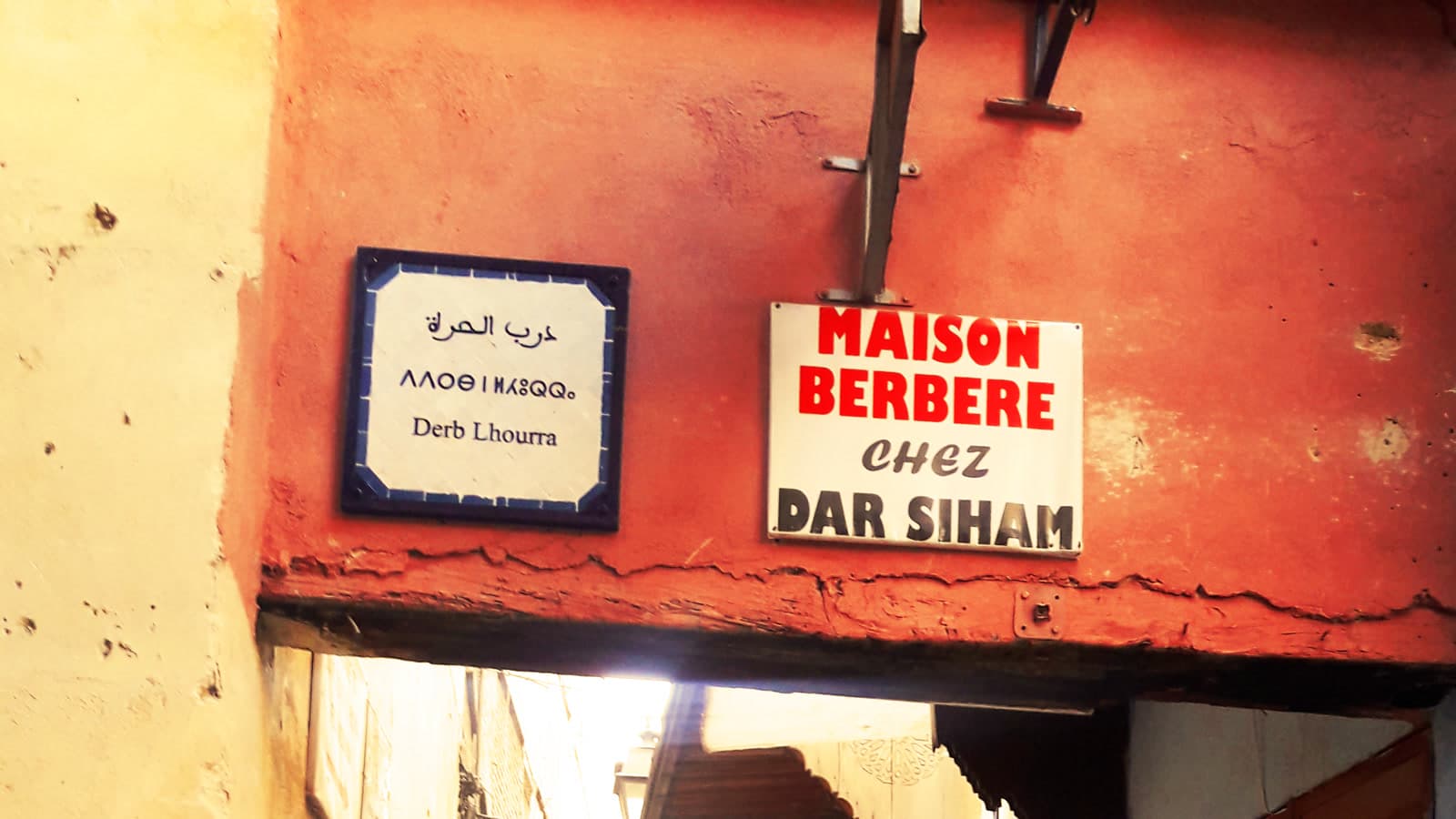
Official status affects institutions, education and public communication over time; it does not mean every person uses both languages in daily conversation. Similarly, a multilingual road sign does not prove that every nearby resident speaks every displayed language.
When citing population data, use the HCP RGPH 2024 platform and name the exact variable, geography, age group and denominator. Unsourced percentages often mix incompatible categories, so this guide does not use a figure without a reproducible table and a matching definition.
For the cultural context behind names, greetings and public etiquette, continue with the Moroccan culture and customs guide.
What is Darija, and is it the same as Modern Standard Arabic?
Darija is Moroccan Arabic as used in ordinary conversation. It is related to Arabic but differs from Modern Standard Arabic in vocabulary, everyday grammar and usage. Modern Standard Arabic is more likely in formal news, official documents and prepared public communication; it is not a substitute for describing how every Moroccan speaks at home.
Darija also varies by speaker and region, and Latin-script spellings are not standardized. The same phrase may be written in several ways online, including with numerals representing Arabic letters. A phrase guide should identify its source and useful variants rather than presenting one Latin spelling as definitive.
For travelers, the practical goal is modest: recognize a greeting, thank someone and explain that you do not understand. A respectful attempt can make an interaction easier, but this guide does not claim that a phrase changes prices or how a vendor will treat you.
What is Amazigh, and where might travelers encounter it?
Amazigh is one of Morocco's official languages and includes regional varieties such as Tarifit, Central Atlas Tamazight and Tachelhit. Which variety is locally relevant depends on the region, so a phrase learned for one area should not be presented as universal throughout Morocco.
Travelers may see the Tifinagh alphabet on public signs alongside Arabic and sometimes French. IRCAM records the royal decision of 10 February 2003 adopting Tifinagh as the official graphic system for Amazigh. Recognizing the script is useful even when a traveler cannot read it: it explains why place names may appear in three scripts.
Use “Amazigh” as the current general term. “Berber” may appear in search queries, older publications and English conversation, but it should be explained as an alternative or historical label rather than automatically treated as every speaker's preferred identity term.
How useful are French, English and Spanish in Morocco?
French, English and Spanish can be useful only when the other person or service supports them. This review found no current official dataset that justifies a country-wide fluency ranking or guarantees a language by city or business type. Ask the exact hotel, transport provider, clinic, pharmacy or tour operator which languages it can support.
Do not treat a major destination or a tourism-facing business as a language guarantee. Confirm important details such as medicine instructions, fares and meeting points in writing or with a trusted translation method. Arrange a qualified interpreter for medical, legal or other high-stakes communication when needed.
The honest planning rule is to match the language to the interaction instead of ranking French, English or Spanish with an unsourced national percentage. If language support matters to a booking or service, obtain confirmation from that provider before relying on it.
Which language should a traveler use in each situation?
Start with the language both people understand, then simplify rather than speaking louder. Names, addresses, numbers and medical terms are safer when shown in writing.
| Situation | First approach | Useful backup |
|---|---|---|
| Hotel or riad | Ask which language the property supports | Written booking confirmation and map pin |
| Train or airport counter | Language offered by the staff and signage | Show the ticket, code and destination in writing |
| Taxi or transfer | Destination name plus map pin | Written address and agreed process before departure |
| Souk or small shop | Greeting plus simple Darija, French or gestures | Calculator or written number for price clarity |
| Pharmacy or clinic | Use the language confirmed by the provider | Written medicine name, allergy details and professional interpreter for complex care |
| Rural community | Ask a host or guide which language is locally useful | Accommodation host, guide or offline translation |
For connectivity and translation access, use the dedicated Morocco SIM and eSIM guide. Telecom prices and coverage do not belong in a language article and should be maintained on that page instead.
Which Moroccan phrases are useful for visitors?
The Peace Corps Moroccan Arabic lessons are a useful training source for basic greetings and practical situations. Transliteration still varies, and pronunciation cannot be validated from text alone.
Review scope: These are source-backed practical forms used in Morocco, not phonetic instructions or a claim that one Latin spelling is standard nationwide. Variants are included where they materially help a visitor.
| Use | Phrase used in Morocco | Practical note |
|---|---|---|
| Hello | Salam alaykum | Response: wa alaykum as-salam |
| Thank you | Shukran | Source-backed meaning |
| Please | Afak | Also written ʿafak or 3afak |
| No, thank you | La, shukran | Also written lla, shukran in some transliterations |
| Where is …? | Fin …? | Add a place name or show it on a map |
| I don't understand | Ma fhemtsh | Also written ma-fhmt-sh or mafhemtch |
| Goodbye | Bslama | Another common spelling is b'slama |
Keep the final published list short enough to practice. A verified set of seven phrases is more useful than twenty mixed Darija, Modern Standard Arabic and French entries with uncertain spelling.
Do you need Darija to travel around Morocco?
You do not need Darija to prepare for a trip, but do not assume another language will work in every interaction. Keep bookings, addresses and map pins in writing, confirm language support where it matters, and use reviewed Darija forms for brief exchanges such as greeting, thanking or declining politely.
Learning a few words should support clear communication, not create false confidence in a medical, legal or safety situation. Use a professional interpreter or trusted bilingual person when accuracy matters. In multilingual areas, let the other person choose the language they prefer rather than assuming identity from clothing, location or appearance.
Language is also part of cultural context. The traditional Moroccan clothing guide explains regional names without treating them as interchangeable, while the Moroccan food guide can help match dish names to what appears on a menu.
In summary
Arabic and Amazigh are Morocco's official languages; Darija is central to everyday conversation, and Hassaniya is used in parts of the south. Verify French, English or Spanish support for each interaction, avoid unsupported national fluency rankings, and keep important details in writing.
Frequently asked questions
What are Morocco's official languages?
Arabic and Amazigh are Morocco's two official languages under Article 5 of the 2011 Constitution. Darija is Moroccan Arabic used in everyday speech, while Modern Standard Arabic is associated more with formal writing and broadcasting. Official status should not be confused with a claim that every resident speaks both languages.
What language do Moroccans speak every day?
Darija is a major language of everyday conversation, but Morocco is multilingual and the answer varies by family and region. Amazigh varieties are important in many communities, and Hassaniya is used in parts of southern Morocco. Confirm any additional language support with the specific person or provider instead of inferring it from a city or business type.
Is Darija the same as Arabic?
Darija is Moroccan Arabic, but it is not identical to Modern Standard Arabic. It has its own everyday pronunciation, vocabulary and grammar, with regional variation. A visitor who studied formal Arabic may recognize elements while still needing time to understand fast spoken Darija.
Is French widely spoken in Morocco?
French is not an official language of Morocco, and this guide does not claim a national or city-level availability rate. Ask the exact hotel, transport provider, clinic or other service which languages it supports. Any percentage should state whether it measures literacy, local language use, mother tongue or self-reported ability.
Can you travel in Morocco using only English?
Do not plan on English being available in every interaction. Confirm support with the exact property or provider, keep addresses and bookings in writing, download offline translation, and use a few reviewed Darija forms. Arrange qualified language support for medical, legal or other high-stakes communication.
Authoritative sources
- Secretariat-General of the Government, Constitution of Morocco, Article 5, current official text checked 31 July 2026 — constitutional and important legal texts
- Haut-Commissariat au Plan, RGPH 2024 interactive platform, checked 31 July 2026 — official census results platform
- Haut-Commissariat au Plan, “Informations essentielles sur le RGPH 2024,” 29 August 2024 — language-variable methodology
- Haut-Commissariat au Plan, Laâyoune–Sakia El Hamra, RGPH 2024 regional results — regional Hassaniya results, checked 1 August 2026
- IRCAM, official Tifinagh commemoration page, decision dated 10 February 2003 — Tifinagh as the official Amazigh script
- IRCAM, Dictionnaire raisonné berbère-français: parlers du Maroc, 2016 — Moroccan Amazigh varieties
- Peace Corps, Moroccan Arabic language lessons, legacy training resource checked 1 August 2026 — basic phrase source; forms are presented with transliteration variants and no phonetic guarantee
Continue with the Moroccan culture and customs guide, traditional clothing guide, Moroccan food guide, Morocco airports guide or Morocco SIM and eSIM guide.