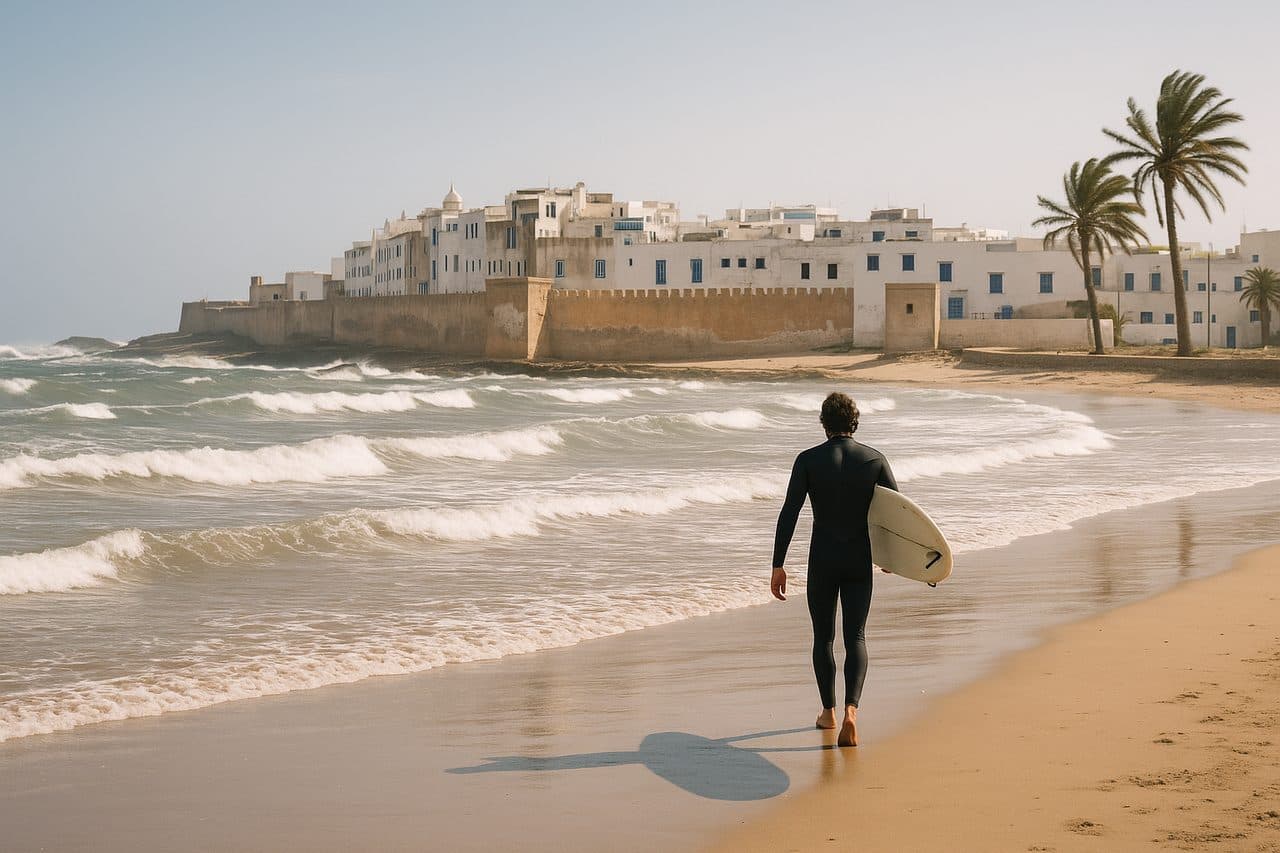

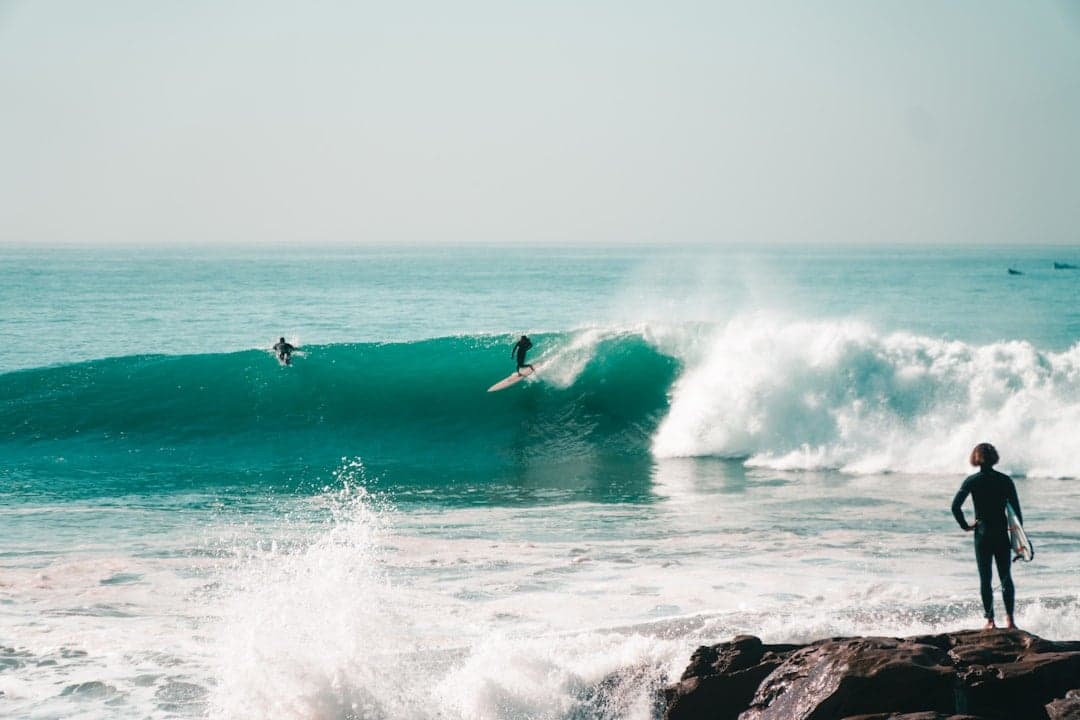
Most “things to do in Morocco” articles mention surfing in a sentence and move on. This guide is the opposite: it’s the surf-trip hub I’d hand a travelling surfer, built around the questions that actually decide your trip — which break matches your level, when the swell shows up, how crowded and how sharp the reef gets, whether to bring a board or rent, and whether to book a camp or go independent. Morocco rewards surfers who plan around level and season, not around a bucket list. Pick your wave honestly and this is a cheap, sunny, point-break paradise a short flight from Europe.
Is Morocco good for surfing? (and can you surf year-round?)
Morocco is genuinely world-class for surfing, and the reason is geography: the central Atlantic coast catches the same North Atlantic swells that light up Portugal and the Canaries, but it bends them around a series of rocky headlands that produce long, mechanical right-hand point breaks — the kind of wave that peels for hundreds of metres. Anchor Point alone delivers rides up to 500 metres on the right day. Add reliable offshore mornings, warm-ish water, and prices a fraction of Europe’s, and you have one of the planet’s best-value surf trips.
Can you surf in Morocco year-round? Yes — but the season changes who it suits. The September–April window is prime: clean swell, light morning winds, the points firing. November to February brings the biggest, most consistent waves (6–12 ft) and the heaviest crowds — that’s expert-and-confident-intermediate season. June to August flips it: the swell drops to 1–3 ft and the water warms to 21–23°C, which is exactly what a beginner wants. So the honest answer is that Morocco surfs all year, but you should match your month to your level. For the full month-by-month swell, wind and crowd breakdown, see our dedicated best time to surf in Morocco guide.
Where are the best surf spots in Morocco?
The famous breaks cluster around Taghazout and Tamraght, and they are not interchangeable — each has a level and a wave type. The headline waves are right-hand points; the learner waves are sandy beach breaks a few minutes south. Here’s the honest level-by-spot breakdown, because sending the wrong surfer to the wrong wave is the single biggest mistake travellers make here.
| Spot | Level | Wave type | Best months |
|---|---|---|---|
| Anchor Point (Taghazout) | Intermediate–advanced | Long right-hand point, best 4–10 ft | Nov–Feb |
| Killer Point (Taghazout) | Intermediate–advanced | Heavy long right point, needs N swell | Nov–Feb |
| Boilers (north of Taghazout) | Upper-intermediate–expert | Hollow right-hand reef barrel | Nov–Feb |
| Banana Point (Aourir) | Beginner–intermediate | Easy long right + wide beach | Oct–Mar |
| Panoramas (Taghazout) | Beginner–intermediate | Sand-bottom; world-class on big swell | Oct–Mar |
| Devil’s Rock (Tamraght) | Beginner–all | Sand-bottom A-frame beach break | Year-round |
| Crocro (Tamraght) | Beginner–intermediate | Sand-bottom A-frames (L/R) | Oct–Mar |
| Imsouane “The Bay” | Beginner–intermediate | Mellow long right point (~600 m rides) | Nov–Mar |
A few notes the table can’t carry. Boilers is named for the rusted ship boiler sitting next to the take-off and the boils of air escaping the reef — it’s a barrel for confident surfers, not a first stop. Killer Point handles giant swell and is best watched from the cliff before you paddle out. And Devil’s Rock in Tamraght — despite the name — is one of the friendliest learning waves in Africa, 200–300 m of sandy A-frames.
Is there a Morocco surf spots map worth memorising?
You don’t need a printed Morocco surf spots map — you need to understand the string of breaks along one coast road (the N1) north from Agadir. Picture it as a line: Agadir city beach (beginner) → Aourir / Banana Point → Tamraght (Devil’s Rock, Crocro) → Taghazout (Panoramas, Anchor Point, Killer, Boilers) → then a longer drive to Imsouane. Everything in the Taghazout cluster is within a 15-minute drive of everything else, which is the whole point: camps and guides chase the best conditions up and down that line each morning. Further north, Essaouira sits on its own as a wind-sports city (more on that below), and pockets like Sidi Kaouki and Mirleft reward surfers who want to escape the crowds.
When is the Morocco surf season?
The Morocco surf season runs September to April, with the engine room in November to February when North Atlantic storms send NW–W groundswell straight onto the Taghazout points. Winter wave heights commonly run 6–12 ft on the open points; shoulder months (Sep–Oct and Mar–Apr) deliver cleaner, slightly smaller, less crowded conditions that many travelling surfers actually prefer. Summer (June–August) is the small, warm, beginner window.
Pack your rubber to the season:
- Sep–Oct & Mar–Apr — water ~18–20°C, 3/2 mm wetsuit, lighter crowds.
- Nov–Feb — water ~16–18°C, 4/3 mm wetsuit, booties worth it on cold dawns; biggest swell, biggest crowds.
- Jun–Aug — water 20–23°C, 3/2 mm or even a shorty; waves 1–3 ft, ideal for learning.
You’ll never need a hood in Morocco — this isn’t cold-water surfing. Most camps include wetsuit hire, so you can travel light. For how the surf calendar fits the wider Moroccan climate (and the inland heat to avoid), cross-check our best time to visit Morocco guide.
Which surf spots are best for beginners?
If you’re learning, base yourself in Tamraght or Aourir, not at the famous points. The best beginner zones are sand-bottom beach breaks where a wipeout means a mouthful of saltwater, not a reef cut:
- Devil’s Rock (Tamraght) — 200–300 m of gentle A-frames over sand; the standout learner wave.
- Crocro (Tamraght) — soft sandy bottom, consistent foamies for pop-up practice.
- Banana Beach (Aourir) — a wide beginner beach beside the easy Banana Point right.
- Imsouane “The Bay” — once you’re standing up, its long, slow right (rides up to ~600 m, up to two minutes) is the perfect place to learn to ride a green wave.
Time it for June to August if you can: the smallest waves (1–3 ft) and warmest water (21–23°C) of the year. Book a few lessons with a local school before you paddle out alone — the dedicated surfing in Morocco for beginners guide walks through lesson packages, what to expect day one, and how to progress from whitewater to the points.
Is surfing in Morocco safe?
Surfing in Morocco is safe for prepared surfers, but it has real hazards that the postcard photos hide — and they’re surf-specific, not the general safety concerns people ask about the country. The three to respect:
- Reef and sea urchins. The points (Anchor, Killer, Boilers) break over rock studded with urchins. Booties are not optional at reef spots — surfers regularly need stitches from urchin spines, and hitting reef on a bad fall causes real injuries.
- Rips and currents. The same point setups that create long rides also create strong channels. Learn the channel from a local or guide before paddling out, especially on bigger winter days.
- Localism and crowds. This is social, not physical, but it shapes your session. On a good winter morning you can share Anchor Point with 50 other surfers, and the local crew rightly gets priority. Say “salam” as you paddle out, wait your turn, and don’t snake three waves in a row.
None of this should put you off — it’s normal surf-travel caution. For the country-level picture (taxis, medinas, scams) that’s separate from the water, our wider safety context lives across the site, but in the lineup, respect and the right footwear cover most of it.
Taghazout vs Essaouira — which surf base?
Short version: for a pure surf trip, base in Taghazout; for wind sports and atmosphere, choose Essaouira. Taghazout is Morocco’s surf capital — point breaks for every level within a 15-minute drive, surf camps on every corner, the whole town built around the ocean. Essaouira is a beautiful walled coastal city with a beach break, but it’s famous for wind: consistent trade winds blow April–October (18–30 knots June–September), which makes it a kitesurf and windsurf mecca and a frustrating place to surf in summer. Essaouira can give fun beach-break days in winter and is the more interesting town to live in, but it rarely replaces Taghazout as a surf base.
If you’re torn — surf-first vs town-and-wind-first — the head-to-head in our Taghazout vs Essaouira for surf guide breaks down waves, wind, vibe and who each suits.
Surf camp vs independent — which should you book?
A surf camp bundles accommodation, daily transport to whichever spot is working, board and wetsuit hire, lessons or guiding, and usually meals. Its real value is spot selection: experienced guides read the morning swell and drive you to the wave that fits your level and the conditions — invaluable on your first trip when you can’t yet call your own session. Camps also solve the social side, which matters for solo travellers.
Independent means renting a riad, apartment or surf house and sorting your own boards and transport. It’s cheaper, more flexible, and better once you can read a forecast, know the spots, and want to surf on your own schedule. Board rental runs about €10 a day in Agadir, Taghazout and Tamraght, so going independent is easy on the board front. For where to stay either way, our accommodation in Morocco guide covers surf houses, riads and apartments, and the is Morocco expensive? breakdown shows how a surf week pencils out versus Europe.
Should you bring your own board or rent in Morocco?
For a one-to-two week trip, renting usually wins unless you fly Royal Air Maroc or are very particular about your board. Rental is cheap (~€10/day), every camp and shop has a quiver, and you skip the airport hassle and oversize-baggage charges that budget carriers love. Bring your own if: you fly RAM (one board free), you’re staying several weeks, you ride an unusual board, or you’re chasing the heavy points where your trusted gun matters. A 6’2″–6’6″ all-rounder and a longboard or mid-length cover most Morocco sessions — the points want something with paddle speed and down-the-line drive. The full airline-by-airline rundown, board-bag packing, and travel-insurance notes are in our flying with a surfboard to Morocco guide.
Lock in your Morocco surf trip
Three decisions, in order, make or break a Morocco surf trip:
- Match month to level. Beginner → June–August (small, warm). Intermediate-plus chasing the points → November–February (big, crowded). Want clean and quiet → September–October or March–April.
- Base in the right town. Surf-every-day → Taghazout/Tamraght. Wind sports + city → Essaouira.
- Camp first, independent later. First trip → book a camp for spot selection and the social side. Returning and confident → go independent and call your own sessions.
Fly into Agadir–Al Massira (AGA), sort a local SIM so you can pull up the surf forecast on the move (our Morocco SIM & eSIM guide covers it), and you’re set. And when the swell goes flat or you want a day off the board, the surf coast is an easy launchpad for the rest of the country — a Marrakech-and-Sahara desert tour or day trips from Marrakech slot neatly onto a surf trip, and Moroccan food is half the reason to come.
Frequently Asked Questions
Q: Can you surf in Morocco as a complete beginner?
Yes. Tamraght’s Devil’s Rock and Crocro, plus Imsouane Bay, are sand-bottom or mellow spots built for first-timers, and summer (June–August) brings 1–3 ft waves and 21–23°C water — ideal learning conditions. Book two or three lessons with a Taghazout-area surf school before you paddle out on your own, and you’ll be standing up within a few sessions.
Q: What wetsuit do I need for surfing in Morocco?
A 3/2 mm wetsuit covers spring, summer and early autumn (water 18–23°C), and a 4/3 mm — booties optional — handles the November–February peak when water drops to 16–18°C. You won’t ever need a hood here. Most surf camps include wetsuit hire in the price, so you can travel without one if you’re booking a package.
Q: Is Anchor Point suitable for beginners?
No. Anchor Point is a long, fast right-hand point break that works best at 4–10 ft and gets very crowded with skilled locals and visiting surfers. It’s an intermediate-to-advanced wave with a rocky bottom. Beginners should learn at Devil’s Rock, Crocro or Imsouane Bay first, then move up to the points once they can confidently catch and ride green waves.
Q: When is the biggest swell in Morocco?
November to February. Winter NW–W Atlantic groundswells push 6–12 ft onto the Taghazout points, and that’s when Anchor Point, Killer and Boilers truly fire — it’s also when the lineups are most crowded, with 50-surfer mornings at the best breaks. September–October and March–April give cleaner, less busy, slightly smaller waves that many travelling surfers prefer.
Q: How do I get to Taghazout to surf?
Fly into Agadir–Al Massira (AGA); Taghazout is about 45 minutes (20 km) north by taxi or transfer, and many surf camps include the airport pickup. Royal Air Maroc carries one surfboard bag up to 23 kg free as checked sports baggage, so flying RAM is the cheapest way to bring your own board. Otherwise rent on arrival for about €10/day.

Sources cited in this guide
- Surf Atlas — Taghazout, Tamraght and Imsouane spot guides (wave type, levels, ride lengths) — thesurfatlas.com/surfing-morocco
- Stormrider Surf Guides — Morocco and Taghazout regional break data — stormrider.surf/region/taghazout
- Surf Berbere — spot-by-spot Taghazout guide (Anchor, Boilers, Killer) — surfberbere.com/surf-spots-taghazout
- Surfline — Imsouane “The Bay” report and forecast — surfline.com
- IKSURFMAG — Essaouira kitesurf and wind travel guide — iksurfmag.com
- Royal Air Maroc — sport-equipment (surfboard) baggage policy — royalairmaroc.com/sport-equipment
Continue your Morocco prep
- Best Time to Surf in Morocco — the month-by-month swell, wind and crowd calendar.
- Taghazout vs Essaouira for Surf — waves vs wind, vibe, and who each base suits.
- Surfing in Morocco for Beginners — lessons, learner spots, and how to progress.
- Flying with a Surfboard to Morocco — airline board-bag fees, packing and rental.
- Best Time to Visit Morocco — how the surf season fits the wider climate.
- Morocco Airports & Flights — flying into Agadir (AGA) and beyond.
- Accommodation in Morocco — surf houses, riads and apartments.
- Is Morocco Expensive? — what a surf week actually costs.
- Morocco SIM & eSIM Guide — stay connected to the surf forecast.
- Moroccan Food Guide — what to eat between sessions.
- Morocco Itinerary — fit a surf leg into a wider trip.
- Marrakech & Sahara Desert Tour — the classic add-on when the surf goes flat.
- Day Trips from Marrakech — and things to do in Marrakech for a non-surf day.