
For most visitors the hammam is the single most authentic — and cheapest — experience in Morocco, and also the most intimidating, because nobody tells you what actually happens behind the door. This is the local’s walkthrough: what a hammam is, the exact ritual step by step, the difference between a 15-dirham neighborhood bath and a 400-dirham spa, what to wear, how to behave, and how much to tip the woman who scrubs you. Once you’ve done it once, you’ll understand why Moroccans have gone weekly for centuries.
What is a Moroccan hammam?
A hammam is a public steam bath — the North African cousin of the Roman bath and the Turkish hamam. Traditionally it’s a neighborhood institution: a series of progressively hotter, tiled rooms heated by an underground furnace (often the same one that fired the local bread oven), where people get genuinely clean, exfoliate, and socialize. The hammam de quartier was where a whole neighborhood bathed, and it remains a weekly ritual for millions of Moroccans today.
There are two worlds under the same word. The public hammam is bare-bones, local, gender-separated, and almost free. The tourist spa hammam wraps the same ritual in candles, towels, and a private suite. Both deliver the same core sequence — steam, black soap, scrub, clay, rinse — and choosing between them is the first real decision you’ll make.
The step-by-step hammam ritual
The ritual is the same whether you’re paying 30 dirhams or 400. In a public hammam you do most of it yourself (or pay an attendant for the scrub); in a spa, a kessala or tayeba guides you through the whole thing. Here’s the full sequence, roughly 90 minutes end to end:
- Undress and store your clothes (~10 min). You strip down to underwear bottoms in a changing room and carry a bucket — the satla — into the wet rooms.
- Warm room, then hot (~25 min). You acclimate in a warm room, then move to the harr, the hottest room, where steam opens your pores. Pour warm water over yourself and just sweat.
- Black soap (~10 min). You coat your whole body in savon beldi and let the olive paste sit 5–10 minutes to soften the skin. It feels slick, not foamy.
- The kessa scrub / gommage (~15–20 min). The attendant works the rough kessa glove in firm circles. Dead skin lifts off in visible grey rolls — confronting the first time, oddly satisfying after. This is the heart of the experience.
- Ghassoul clay mask (~10–15 min). Atlas clay, often mixed with rose water, is smoothed over skin and hair, then rinsed.
- Rinse, cool down, rest (~25 min). You rinse with cooler water, then sit, rehydrate, and drink mint tea. Skin comes out genuinely baby-soft.
Public neighborhood hammam vs tourist spa hammam
This is the choice that defines your experience. A public hammam is cheap, loud, social, and gloriously authentic — but you bring your own kit and nobody speaks English. A spa hammam is calm, guided, and tourist-friendly, for several times the price. Here’s the honest comparison:
| Public neighborhood hammam | Tourist spa hammam | |
|---|---|---|
| Price | ~10–50 MAD entry; +50–150 MAD if an attendant scrubs you (full local visit ~150–250 MAD) | ~150–400 MAD for entry + gommage; full packages 300–700 MAD |
| Vibe | Steamy, communal, chatty, no-frills, very local | Quiet, candlelit, private or small-group, spa-like |
| What’s included | Bare room + hot water. You bring towel, savon beldi, kessa, ghassoul | Soap, kessa scrub, clay, towels, often argan-oil massage + tea |
| Language | Darija/French only | English usually spoken |
| Who it’s for | Confident travelers wanting the real thing | First-timers, couples, anyone wanting comfort and guidance |
What to wear and what to bring to a hammam
You are never fully nude. In a public hammam, women typically wear underwear bottoms (many go topless; it’s normal and nobody looks); men wear underwear or swim shorts. In a spa hammam, you’re usually given disposable mesh briefs, and dark swim bottoms or a bikini bottom are fine. Bring or wear flip-flops — the floors are hot and wet.
For a public hammam, pack your own kit, since the room is bare:
- A towel (or two) and flip-flops
- Savon beldi (black soap), a kessa glove, and ghassoul clay — buy all three in the medina for ~15–20 MAD each
- A satla (plastic bucket) if not provided, a small stool, shampoo
- A dry change of underwear and a comb
A spa provides all of this. Either way, leave jewelry and valuables at your riad — there’s nowhere secure inside.
Hammam etiquette — the unwritten rules
A few simple norms keep you on the right side of the room. Greet people with “salam” on the way in. Keep your underwear bottoms on. Don’t photograph anything. Sit on a stool or your towel, not directly on the marble where others will sit. Use a modest amount of water and rinse your spot when you leave. If you booked an attendant scrub, agree the price before you start so there’s no awkwardness after.
Tipping the kessala (the person who scrubs you) is expected: 20–50 MAD at a public hammam, 30–50 MAD at a boutique spa, more at luxury hotels. Bring small notes — there’s no card machine in the steam, and breaking a 200 is nobody’s idea of relaxing. For the wider tipping picture across taxis, riads, and restaurants, see our tipping in Morocco guide.
First-timer tips
- Don’t over-scrub. Once a week is plenty for locals; once on your trip is right for you. Daily scrubbing strips the skin barrier — that grey roll is your protective layer, so resist asking for “harder, again.”
- Hydrate before and after. The harr is hot; you’ll sweat a lot. Drink water going in and mint tea coming out.
- Go in the morning or early afternoon. Public hammams get busiest Thursday evenings and Friday mornings, the traditional pre-weekend wash.
- Bring 50 MAD in small notes for the attendant and any kit you buy on the way in.
- Manage your modesty actively. If topless feels like too much for a first public visit, keep a bikini top on — but a spa will be far more comfortable. This matters especially for solo travelers; our solo female Morocco safety guide covers reading the room in single-sex spaces.
Where to go — hammams in Marrakech and beyond
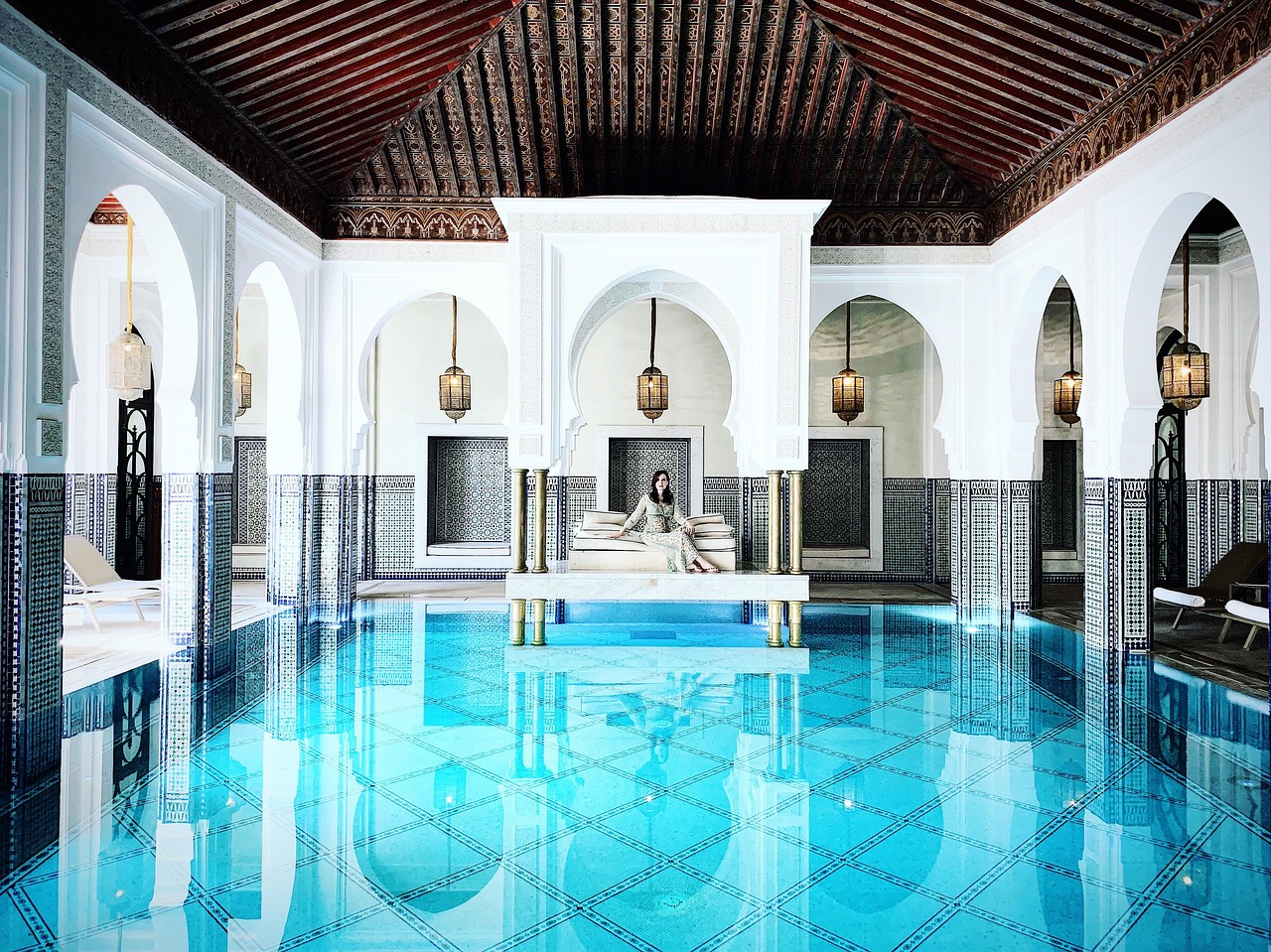
Marrakech is the easiest place to try a hammam, with options at every price point. Boutique spa hammams like Les Bains de Marrakech, Heritage Spa, and Les Bains d’Orient sit in the 300–700 MAD range; luxury hotel hammams (Royal Mansour, La Mamounia, La Sultana) start around 1,600 MAD. For the public version, ask your riad to point you to the nearest hammam de quartier — there’s one in almost every neighborhood. A hammam pairs perfectly with a medina day; see our roundup of things to do in Marrakech, and if it’s your first time in the city, is Marrakech safe? covers the medina basics.
Beyond Marrakech, Fes has historic hammams attached to its old mosques, and most riads anywhere in the country can arrange a private hammam in-house. Many travelers slot a hammam into a slower city day — it’s a natural fit on the Marrakech leg of a Morocco itinerary, and a good wind-down after the Sahara dust. If you’d rather not navigate it alone, a private Morocco tour can book a vetted hammam for you.
How much does a Moroccan hammam cost?
Across the spectrum, here’s what 2026 prices actually look like (≈10 MAD to the US dollar):
- Public entry only: ~10–50 MAD ($1–5) — you do everything yourself.
- Public + attendant scrub: ~150–250 MAD ($15–25) all in.
- Boutique/tourist spa hammam + gommage: ~150–400 MAD ($15–40) for the core ritual; full packages with massage 300–700 MAD.
- Luxury hotel hammam: 1,600–3,600 MAD ($160–360) for a private suite and signature treatment.
- Your own kit (savon beldi + kessa + ghassoul): ~50 MAD total from the medina.
For where a hammam fits in a wider trip budget, our Morocco itinerary cost framework breaks down a full week. The takeaway: there is no cheaper way to feel like you actually lived a Moroccan tradition.
Women vs men — separate sections and hours
Public hammams never mix genders. Larger ones have two separate wings; smaller ones run men’s hours and women’s hours on a daily rotation (commonly women by day, men in the evening — but it varies, so always check). Women scrub women, men scrub men. The women’s hammam in particular is a famously social space — neighbors catching up, mothers and daughters — and one of the few places you’ll see local life completely unguarded. Spa hammams sidestep all this with private or couples’ rooms, part of what you’re paying for. For the broader context, see our Moroccan culture and customs guide and notes on traditional Moroccan clothing.
Frequently Asked Questions
Q: What do you wear in a Moroccan hammam?
You’re never fully naked. In a public hammam, women wear underwear bottoms (going topless is common and unremarkable) and men wear underwear or swim shorts. In a tourist spa hammam you’re usually given disposable mesh briefs, and dark swim bottoms or a bikini bottom are perfectly acceptable. Always wear flip-flops, since the tiled floors are hot, wet, and slippery.
Q: Is a hammam worth it?
Absolutely — it’s the cheapest authentic experience in Morocco and leaves your skin genuinely transformed. A public neighborhood hammam costs as little as 10–50 MAD to enter, and even a comfortable tourist spa version with the full scrub runs only 150–400 MAD (around $15–40). For most visitors it’s a trip highlight, and a weekly ritual locals have kept for centuries.
Q: What is the difference between a hammam and a spa?
A hammam is the specific steam-bath ritual: hot rooms, savon beldi black soap, and the vigorous kessa scrub. A spa is a broader wellness venue offering massages, facials, and treatments. In Morocco the two overlap — most tourist “spas” are built around a private hammam — but a true public hammam de quartier is just the bath and scrub, with no massage menu and a fraction of the price.
Q: Does the hammam scrub hurt?
No, but it’s vigorous. The kessa glove is deliberately rough so it lifts off dead skin, which can feel intense the first time, especially on sensitive areas. It shouldn’t be painful. If the pressure is too much, say “bshwiya” (gently) and the attendant will immediately ease off. Skip the scrub entirely if you have sunburn or broken skin.
Q: How often do Moroccans go to the hammam?
Traditionally about once a week, often timed to Thursday evening or Friday morning ahead of the weekend and Friday prayers. That weekly rhythm is why public hammams are busiest at those times. As a visitor, once per trip is right — over-scrubbing strips your skin’s protective barrier, so resist the urge to go every day.

Sources
- Office National Marocain du Tourisme (ONMT) — Moroccan tourism and cultural context — visitmorocco.com
- Encyclopædia Britannica — Hammam / North African and Turkish bath tradition — britannica.com
- Wikipedia — Rhassoul (ghassoul) mineral clay, Moulouya valley, Atlas Mountains — en.wikipedia.org/wiki/Rhassoul
- Wikipedia — Hammam (history and ritual of the bathhouse) — en.wikipedia.org/wiki/Hammam
- UNESCO World Heritage Centre — Medina of Marrakech (1985), Medina of Fes (1981), historic bath context — whc.unesco.org
Continue your Morocco prep
- Things to Do in Marrakech — pair your hammam with a full medina day.
- Is Marrakech Safe? — first-timer basics for the city’s medina.
- Moroccan Culture & Customs — the etiquette that decides how locals treat you.
- Tipping in Morocco — how much for the kessala, taxis, riads, and guides.
- Traditional Moroccan Clothing — what locals wear, around the bath and beyond.
- Solo Female Morocco Safety Guide — reading single-sex spaces with confidence.
- Accommodation in Morocco — riads that arrange a private in-house hammam.
- Morocco Itinerary — where a hammam fits in a 5, 7, or 10-day plan.
- Moroccan Food Guide — what to eat (and the mint tea waiting after your scrub).
- Best Time to Visit Morocco — month-by-month, region-by-region.
- Private Morocco Tours — have a local book a vetted hammam for you.