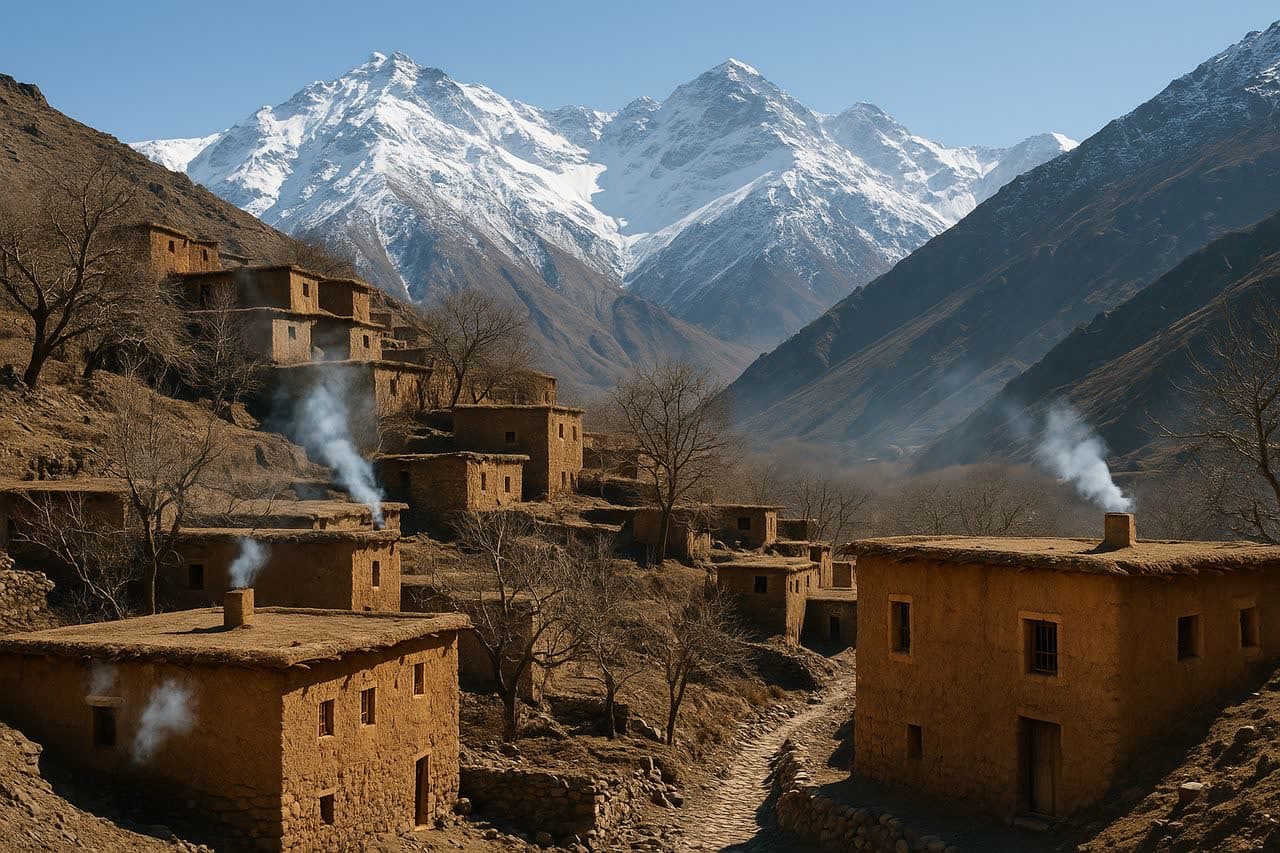

If you’ve trekked Toubkal in summer and assume winter is the same walk-up with a warmer jacket, this guide is the reality check before you book.
The summer route is a non-technical walk-up — a hard slog at altitude, no special skills. Winter changes the mountain completely: the scree track you’d amble up in July becomes a steep, exposed snow slope, the saddle below the summit funnels wind, and the descent is where most winter mishaps happen. This is the honest skill-and-kit bar for stepping up from trekker to winter mountaineer on Jebel Toubkal — written for people whose biggest fear is under-preparing.
How hard is winter Toubkal compared with the summer walk-up?
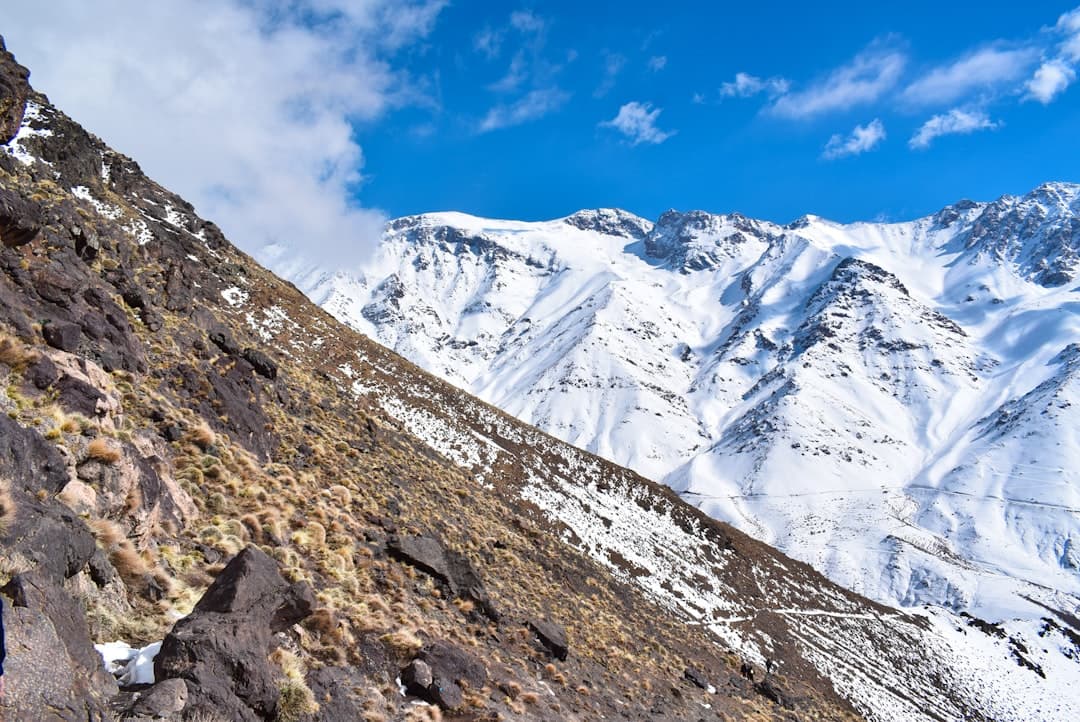
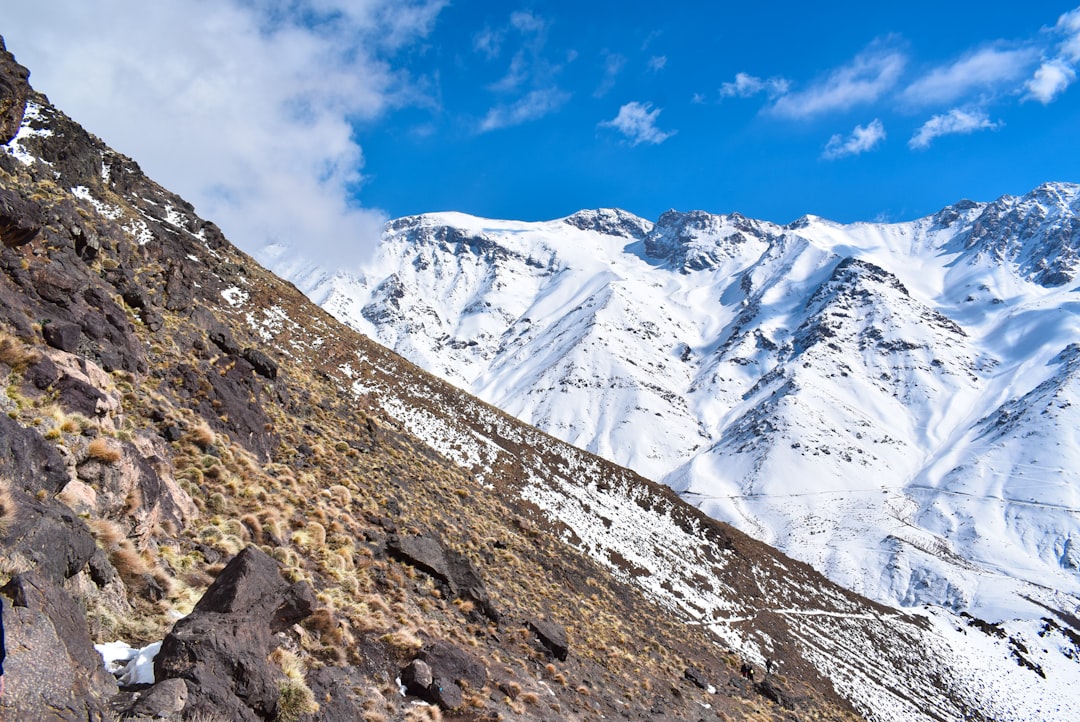
The route is the same: Imlil (≈1,700 m) → Toubkal Refuge (3,207 m) → summit (4,167 m). What changes is everything underfoot. In summer this is a non-technical walk-up peak, done over about five days from Imlil with no mountaineering skills required. In winter it becomes a genuine alpine ascent — still an entry-level 4,000 m winter peak, but one that demands real equipment and tolerance for a harsh environment.
The difference shows up on summit day. In summer the route crosses a saddle between Toubkal and Toubkal Ouest, then a scree track that avoids the exposed edges. In winter that same track is far steeper and more exposed, and if it’s firm or icy your guide may rope the group together. Summit day runs roughly 8–10 hours round-trip (about 5–7 up, 3–4 down) with a pre-dawn start around 5 AM.
If you’re weighing the seasons, our Mount Toubkal trek guide covers the summer walk-up in full, and the dedicated best time to climb Toubkal page breaks down every month.
When is the winter season on Toubkal?
Winter conditions run roughly December through April, with the most reliable snow from December to February. Snow is generally present from early January to mid-May, though some years run longer or shorter. Heavy, short bursts of snow and rain are common as moist Atlantic air is forced up over the High Atlas.
For a first winter ascent, late January through March is the sweet spot: deep enough snow to need full winter technique, but with longer daylight and often more settled snowpack than mid-December. Guides frequently regard February as the prime window.
| Month | Snow / conditions | Notes for climbers |
|---|---|---|
| December | Snow building; variable cover | Short daylight; cold; snowpack can be thin early |
| January | Reliable deep snow | Coldest; full winter kit essential; avalanche awareness begins |
| February | Deep, often more settled snow | Frequently the prime window — good cover, lengthening days |
| March | Good snow, more daylight | Solid choice; warming trends raise afternoon avalanche risk |
| April | Snow receding on lower slopes; cone still wintry | Transitional — crampons/axe still needed up high |
What kit do I need for winter Toubkal?
This is the section most trekkers skim and later regret. The line that matters: own and know how to use the technical pieces (axe, crampons), but the bulky basics can be rented in Imlil. Here’s the working kit list.
| Item | Why it’s needed | Notes |
|---|---|---|
| Crampons | The snow/ice on the cone and traverses is un-walkable without them | 12-point, must fit your boots; rentable in Imlil (~£35 for axe + crampons combined) |
| Ice axe | Self-arrest if you slip on a steep slope; balance on the cone | Walking/mountaineering axe, length-matched; rentable in Imlil — but learn the self-arrest first |
| B2 or B3 mountaineering boots | Stiff sole needed to take crampons and kick steps; insulation against frostbite | B2 covers most Toubkal winters; B3 for hard ice. Trekking boots will not hold crampons |
| Gaiters | Keep deep snow out of your boots | Waterproof, full-height |
| Insulated down jacket | Belay/standing warmth at the refuge and on the cone | Packs into your daypack |
| Hardshell jacket + pants | Wind and spindrift protection in 40 km/h gusts | Fully waterproof/windproof outer layer |
| Layered base + mid | Thermal base + fleece mid under the shell | Avoid cotton; layer up/down on the move |
| Waterproof gloves + spare | Hands fail fast in wind; a wet pair ends your day | Carry a backup pair; liner gloves help |
| Hat + buff/balaclava | Face and head are where windchill bites | Balaclava for the summit push |
| Glacier/UV sunglasses + SPF | Snow glare at altitude burns eyes and skin | High-UV category; lip balm too |
| −10 °C+ sleeping bag | The refuge is heated but cold; some nights dip to freezing | Check with your operator — some provide bedding |
Do I need crampons and ice-axe skills?
Yes — both the equipment and the skills. Crampons and an ice axe are genuinely necessary in winter to move safely over snow and ice, and every reputable operator states you must know how to use them. The good news: a competent guide provides on-the-mountain training — usually a session near the refuge covering crampon technique and, critically, ice-axe self-arrest (stopping yourself after a slip).
The skill that saves you isn’t fancy; it’s the self-arrest, plus confident footwork in crampons on a 30–40° slope. Arrive having watched a YouTube clip and nothing more, and you’re relying entirely on conditions being kind. They often aren’t.
Do I need a guide for winter Toubkal?
For winter, treat a guide as non-negotiable — and in Morocco it’s also a legal point: a licensed local mountain guide is a legal requirement for foreigners on Toubkal, summer or winter. In winter the guide does far more than navigate: they read avalanche terrain, decide whether to rope up, choose the safer descent line, and make the turn-around call when wind or snow shut the cone down.
We go deeper on the rules, costs, and how to vet a qualified guide in do you need a guide for Toubkal?. If you’d rather have the whole logistics chain — guide, refuge booking, transfers from Marrakech — handled end to end, that’s exactly what GuideMe’s private Morocco tours and guides arrange.
How cold does it get — and what about windchill?
Cold, but rarely record-breaking — the danger is the wind, not the thermometer. Rough winter numbers along the route:
| Location | Altitude | Typical winter temp | Wind |
|---|---|---|---|
| Imlil (trailhead) | ≈1,700 m | 5–15 °C daytime | Light–moderate; snow possible |
| Toubkal Refuge | 3,207 m | Around 0 °C / freezing | Gusts to ~40 km/h |
| Summit | 4,167 m | Around −10 °C, down to −15 °C at dawn | Gusts to ~40 km/h |
A −10 °C summit in still air is manageable in the kit above. The same −10 °C in a 40 km/h gust on the exposed cone at first light is what turns climbers around — windchill, not the raw figure, is the deciding factor. This is why summit pushes start at ~5 AM: you want to be up and descending before the afternoon wind and warming kick in.
Is the avalanche and conditions risk real?
It’s real but manageable — which is precisely why the guide matters. Heavy snowfalls, especially January through March, carry an inherent avalanche risk, raised further by warming trends after fresh snow. The risk is generally assessed as small when the terrain is read properly, and a common winter tactic is to descend the west side to avoid avalanche-prone slopes.
Conditions shift fast: the exposed winter line on the cone can be straightforward in firm névé and genuinely serious in fresh wind-slab. A good guide changes the route, the timing, or calls the summit off based on the day — so treat any “guaranteed summit” winter marketing with suspicion. For the broader picture, see our is Morocco safe? briefing.
What is the Toubkal Refuge like in winter?
You’ll base out of the Toubkal Refuge (Les Mouflons) at 3,207 m, the launch pad for summit day. In winter it’s a welcome shelter: heated common areas, hot meals, and dormitory bunks — warmer than a tent, but still cold enough at night that a proper sleeping bag is wise. There’s a second refuge nearby; most guided winter trips use one of the two.
Expect a sociable but early night: groups eat, get their morning kit laid out, and turn in well before the ~5 AM start. Don’t expect hotel comfort — expect a dry, warm-ish room at altitude, which after a snowy approach feels like luxury. If you’re planning where to stay before and after the mountain, our accommodation in Morocco guide covers Imlil and Marrakech bases.
What does a winter Toubkal itinerary look like?
Most guided winter ascents run over about three to five days, structured to acclimatize and bank a skills session before the summit push:
- Day 1 — Transfer from Marrakech to Imlil (≈1,700 m); sort and fit rented crampons/axe; trek toward the refuge.
- Day 2 — Reach the Toubkal Refuge (3,207 m); ice-axe self-arrest and crampon training on a safe nearby slope; early night.
- Day 3 — Summit day: ~5 AM start, 5–7 hours up the snow cone to 4,167 m, 3–4 hours down; return to the refuge or Imlil.
- Day 4–5 — Buffer/weather day and return transfer to Marrakech.
A weather buffer day is the single best line item you can add — winter summit windows open and close fast, and a flexible day turns a wind-bound trip into a successful one. Slot the climb into a wider trip using our Morocco itinerary planner, and check the regional Morocco weather and best time to visit before locking dates.
Recommended action — build the skills, then book the window
If winter Toubkal is your step up from trekking, do it in this order:
- Get the self-arrest dialed. A single guided winter-skills day in the Atlas (or at home before you fly) is worth more than any gear purchase.
- Pick your window. Aim late January–March for the best mix of real winter conditions, daylight, and snowpack stability.
- Book a licensed guide and the refuge together — and insist the itinerary includes a crampon/axe training block and a weather buffer day.
- Rent the bulky metal in Imlil (crampons + axe ≈ £35), but bring your own B2/B3 boots, gloves, and shell.
- Treat any “guaranteed summit” claim as a red flag. The mountain decides; a good guide just reads it well.
If you’d rather hand the whole chain to a local team, GuideMe’s private Morocco tours and guides build the guide, refuge, kit, and transfers around your dates with one WhatsApp contact.
Want a winter Toubkal plan matched to your experience level? Message Anass on WhatsApp →
Frequently asked questions
Q: Can a fit hiker with no winter skills climb Toubkal in winter?
Only with a guide and on-the-mountain training. Fitness gets you to the 3,207 m refuge, but the snow-and-ice summit cone needs crampon technique and an ice-axe self-arrest. Reputable operators teach these at the refuge before summit day. Arriving with zero snow experience and no guide is how people get hurt — it’s also illegal for foreigners, who must climb with a licensed local guide.
Q: Can I rent crampons and an ice axe in Imlil?
Yes. Crampons and an ice axe can be hired in Imlil for roughly £35 for the pair, which is the sensible option if you don’t own them. The catch is competence: rented metal is useless without the skill to use it. Bring your own B2 or B3 mountaineering boots though — rental boots are scarcer, and trekking boots won’t take crampons or kick steps in firm snow.
Q: How cold does the Toubkal summit get in winter?
Expect around −10 °C on the summit, dropping toward −15 °C on early-morning summit attempts. The bigger factor is windchill: summit-zone gusts reach about 40 km/h, which makes −10 °C feel far colder and is the usual reason climbers turn back. The refuge at 3,207 m hovers near freezing, and Imlil at the trailhead stays a milder 5–15 °C by day.
Q: Is winter Toubkal a technical climb?
No — it’s a non-technical winter ascent, not a roped rock or ice climb. But “non-technical” doesn’t mean easy: the summit cone is steep and exposed, much more so than the summer scree track, and guides may rope the group together in firm or icy conditions. You need crampon and ice-axe competence and good fitness, but no advanced climbing skills.
Q: When is the best month for a winter Toubkal ascent?
December to February gives the most reliable snow, but late January through March is the sweet spot for a first winter summit — deep enough snow for the full experience, with more daylight and often more settled snowpack. February is frequently regarded as prime. April is transitional: lower slopes melt out, but the cone stays wintry and crampons and an axe are still needed up high.

Sources cited in this guide
- Wikipedia — Toubkal — summit altitude (4,167 m), “highest peak in North Africa and the Arab world” — en.wikipedia.org/wiki/Toubkal
- UKClimbing — Climbing Toubkal: Summer Trekking and Winter Mountaineering — summer vs winter character, exposed summit cone, roping up — ukclimbing.com
- Call to Adventure — Toubkal in Winter & Jebel Toubkal Weather — temperatures, winds, summit-day hours, crampon/axe rental cost — calltoadventure.uk
- Altura Expeditions — Best Time to Climb Toubkal: Seasonal Analysis and Gear — seasonal temps (−10 to −15 °C), required winter gear — alturaexpeditions.com
- Toubkal Refuge (Les Mouflons) — refuge altitude (3,207 m) and facilities — refugetoubkal.com
- Morocco Countryside Tours — Climbing Mount Toubkal in Winter: Challenges & Safety — avalanche risk, guide requirement, west-side descent — moroccocountrysidetours.com
- Adventure Alternative — Climb Mount Toubkal (Summer & Winter) — non-technical summer walk-up, licensed-guide requirement — adventurealternative.com
- Hiking in London — Winter Ascent of Mount Toubkal: Gear & Itinerary — B2/B3 boots, gaiters, layering system — hikinginlondon.co.uk
Continue your Toubkal prep
- Mount Toubkal Trek Guide — the full summer walk-up route, day by day (the hub).
- Do You Need a Guide for Toubkal? — the legal rule, costs, and how to vet a qualified guide.
- Best Time to Climb Toubkal — month-by-month conditions for summer and winter.
- Best Time to Visit Morocco — regional weather to lock your travel dates around.
- Accommodation in Morocco — where to base in Imlil and Marrakech.
- Is Morocco Safe? — the honest safety briefing, including the mountains.
- Morocco Itinerary Planner — slot a Toubkal ascent into a wider 7–14 day trip.
- Private Morocco Tours & Guides — let a local team build the guide, refuge, and transfers around you.