If you came to Morocco for music, the country rewards the curiosity. Each region has its own sound — Gnawa anchors the Atlantic coast, Andalusi orchestras play in Fes and Tetouan, Chaâbi soundtracks every wedding from Casablanca to Tangier, Berber Ahidous fills the Middle Atlas. This guide walks through what you’ll actually hear, where to hear it, and the etiquette that keeps you welcome.
What is Moroccan music?
Moroccan music is the soundtrack of the same four-civilization layering that shapes everything else here — Berber, Arab, Andalusian, and sub-Saharan African — plus a French Protectorate-era pop influence that bleeds into modern recordings. The result is a wider tonal range than most Western audiences expect from “North African” music: you can hear something that sounds like trance ritual in the morning, classical chamber music in the afternoon, and a wedding-floor pop banger by 11pm without leaving the same city.
The five major traditions you’ll encounter as a visitor: Gnawa (ritual trance with Sub-Saharan African roots), Andalusi (the classical orchestral tradition that came from Granada in 1492), Chaâbi (popular dance/wedding music), Malhoun (sung classical poetry), and Raï (the cross-border genre shared with Algeria). On top of these you’ll hear modern Moroccan pop, hip-hop in the cities, and Berber regional music. UNESCO has formally inscribed Gnawa music on its Intangible Cultural Heritage list in 2019, alongside falconry (2010), argan oil (2014), couscous (2020), and the Sefrou Cherry Festival (2012).
Gnawa — Morocco’s UNESCO-listed trance music
Gnawa is the most distinctive Moroccan musical tradition and the easiest one for visitors to recognize once they’ve heard it twice. Its origins trace to sub-Saharan slaves brought to Morocco from the 16th century onwards — primarily Mali, Senegal, Sudan, Ghana — who fused Bambara, Hausa, and Songhai rhythms with North African Sufism. The result is a hypnotic, percussive ritual music designed to induce trance.
The sound: a three-string bass lute called the guembri carries the melodic foundation, while pairs of iron castanets called qraqeb (or karkabou) layer interlocking rhythms on top. Vocals are call-and-response. In traditional ritual settings (lila ceremonies, all-night healing rituals tied to colour and spirit), the music can run from sunset to dawn — and the percussion is genuinely designed to alter consciousness.
Where to hear it live: the Gnaoua World Music Festival in Essaouira (every June since 1998) is the global flagship — three days, multiple stages, around 500,000 attendees, completely free and open. Outside the festival, Marrakech’s Jemaa el-Fna has Gnawa performers nightly (tip 20-50 MAD for a song), and riads in Essaouira often host evening Gnawa sessions for 100-200 MAD per person.
Etiquette: if you stumble onto a ritual lila in a private home, don’t film without explicit permission — this is sacred music for participants, not a tourist show. Festival performances are public and recording is fine, but ask before close-up shots of performers.
Andalusi — the classical music brought from Granada in 1492
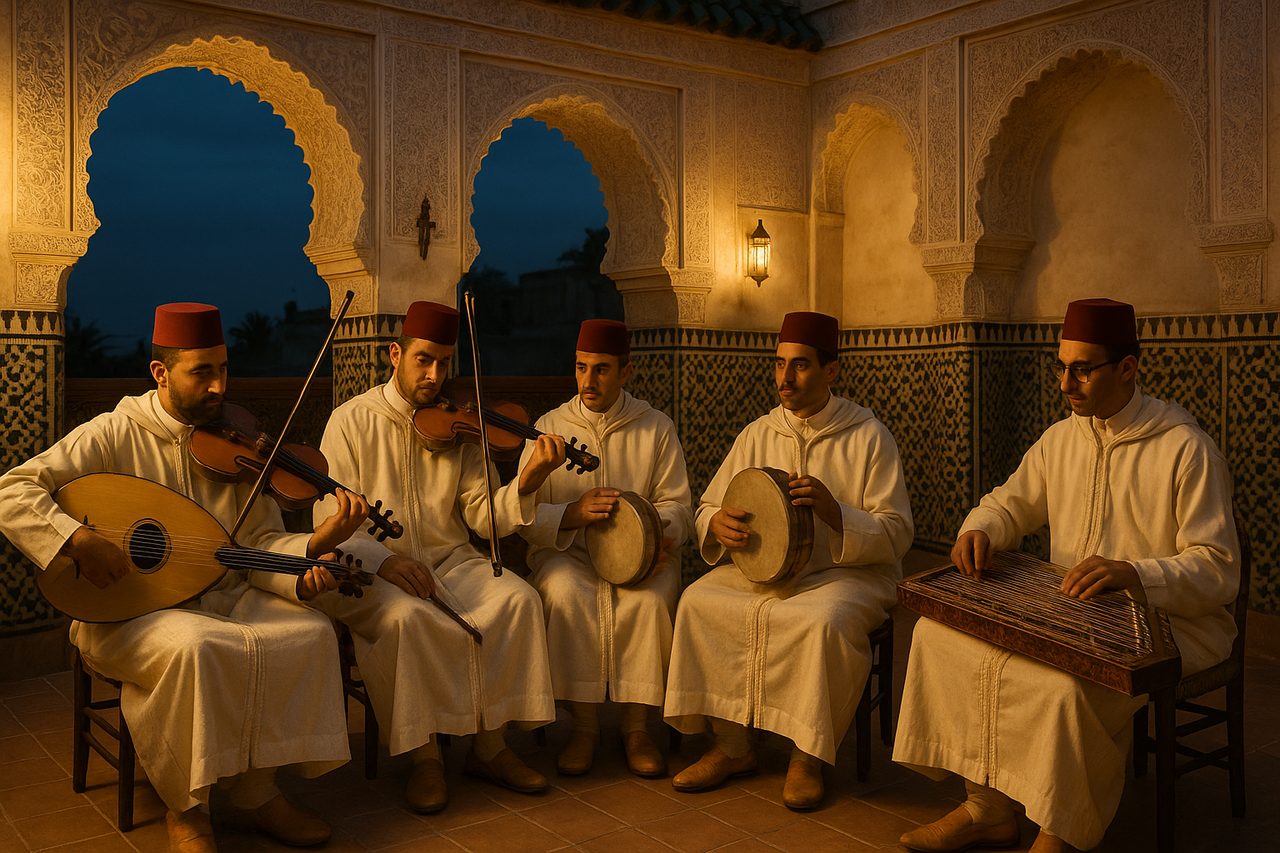
When the Catholic monarchs expelled the Moors and Jews from Andalusia after the fall of Granada in 1492, generations of musicians and composers carried their classical tradition across the strait and resettled in Fes, Tetouan, and Tangier. The Andalusi orchestral tradition that survived in Morocco is, in some ways, older than anything still performed in modern Spain.
The sound: classical chamber-orchestra music with the oud (lute), kamanja (violin held vertically on the knee), tar drum, riq tambourine, rebab spike fiddle, and kanun (zither). Pieces are organized into long suites called nubas (or nawbas) — there are 11 traditional nubas, each tied to a specific time of day, season, and emotional register, like Indian raga.
Where to hear it: the Fes Festival of World Sacred Music (late May / early June, since 1994) regularly features Andalusi orchestras from across the Maghreb. Tetouan has the Conservatoire de Musique Andalouse, and high-end riad dinners in Fes often book a small Andalusi ensemble for evening performances (150-400 MAD per guest). The Marrakech Popular Arts Festival in July also showcases regional Andalusi groups.
Chaâbi, malhoun, raï — the popular music people actually listen to
These three categories make up most of what Moroccans actually play at home, in taxis, and at celebrations.
Chaâbi (literally “popular”) is the dance-floor tradition that exploded in the 1970s-1990s, mixing Moroccan folk rhythms with Egyptian and Algerian pop. It’s the dominant wedding music, played by orchestres chaâbi — typically synth + electric oud + percussion + a male or female lead singer. If you’re invited to a Moroccan wedding, expect chaâbi from 22:00 onwards; by 01:00 the dance floor is full.
Malhoun is the older, more refined cousin — sung poetry in classical Moroccan Arabic dialect, urban roots in Fes, Meknes, and Marrakech, lyrically about love, mysticism, and Andalusian nostalgia. It’s intimate, often performed by a soloist with oud accompaniment, and is what you’d hear in a serious classical-music riad concert rather than at a party.
Raï is the cross-border music shared with western Algeria. The genre’s roots are in Oran in the 1970s; in Morocco it’s strongest in Oujda and the eastern border regions, with a similar pop-influenced electric arrangement to chaâbi. Raï crossed over internationally in the 1990s through Khaled and Cheb Mami.
You’ll also hear modern Moroccan pop (Saad Lamjarred, RedOne, Nass El Ghiwane — the legendary 1970s folk-protest group), Moroccan hip-hop (Don Bigg, Toto, Issam) on every Casablanca radio station, and Berber music in the Atlas (Imedyazen, Idir-influenced groups) and Souss (Ammouri Mbark and the Houara percussion tradition).
Traditional instruments — oud, bendir, qraqeb, ghaita, and the rest
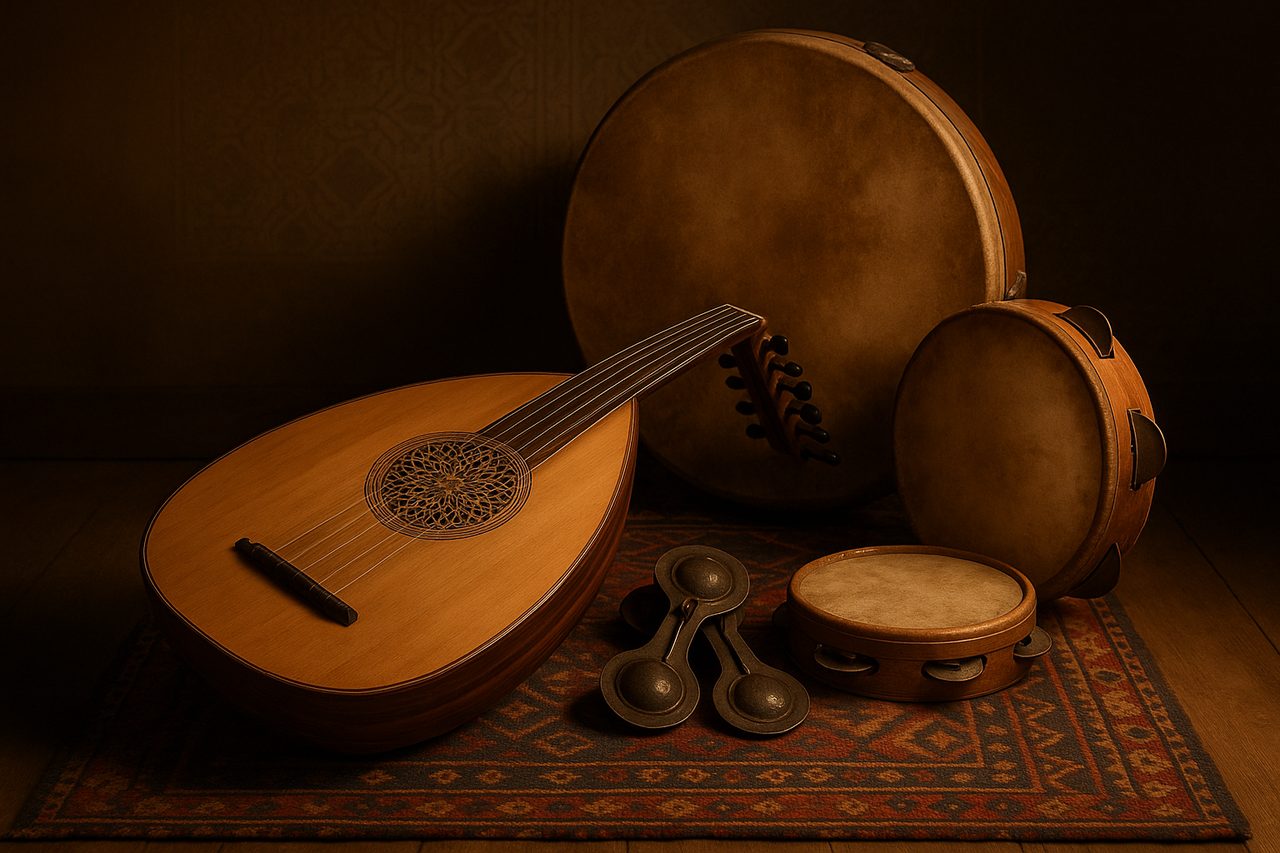
The core kit you’ll see across most Moroccan musical contexts:
| Instrument | What it is | Used in |
|---|---|---|
| Oud | 11-string lute, fretless | Andalusi, Chaâbi, Malhoun |
| Bendir | Large frame drum with snare strings | Folk, religious, Berber |
| Qraqeb | Iron castanets played in pairs | Gnawa (signature) |
| Guembri | 3-string bass lute with camel-skin head | Gnawa (signature) |
| Ghaita | Double-reed oboe, very loud | Berber celebrations, parades |
| Riq | Tambourine with cymbals | Andalusi, classical |
| Kamanja | Violin held vertically on the knee | Andalusi |
| Kanun | 78-string trapezoidal zither | Andalusi |
| Tar | Large frame drum | Andalusi, religious |
Beyond these, modern chaâbi and Moroccan pop heavily feature synthesizers (in the 1980s-90s explosion, the Yamaha synth defined the genre’s sound) and electric guitars in regional and folk-revival groups.
If you want to buy an instrument as a souvenir: a tourist-quality oud runs 800-2,500 MAD in Marrakech’s instrument souks; a serious concert-grade oud from a Tetouan or Fes maker runs 5,000-30,000+ MAD. Qraqeb cost 100-300 MAD per pair. Bendir 200-600 MAD. See our traditional clothing pillar for the broader souk shopping context.
Moroccan dance — Shikat, Houara, Ahidous, and what you’ll see at weddings
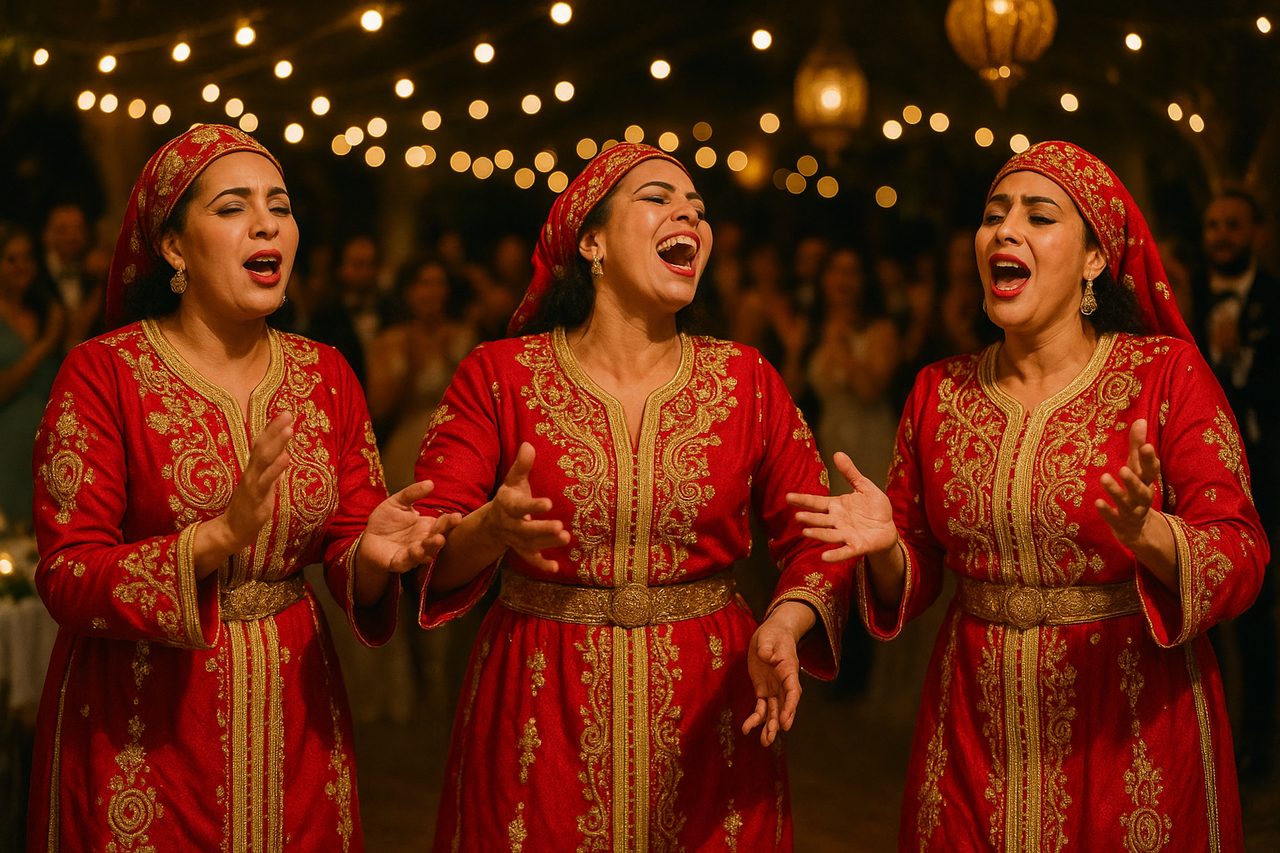
Moroccan dance is regional. The forms you’re most likely to encounter:
Shikat (or Cheikhat): professional female wedding-entertainment performers — singers and dancers in elaborate caftans with belted-on coin sashes that jingle when they move. Shikat books a wedding from late evening, performs popular chaâbi songs, and gets the older guests dancing. They’re the heartbeat of Moroccan weddings.
Houara: men’s high-energy dance from the southern Souss region (Taroudant, Tiznit), performed in a circle with sticks. Drums, ghaita, and synchronized footwork. You’ll see it at folkloric festivals and in tourist shows in Agadir and Marrakech.
Ahidous (also Ahidoues): Berber group dance from the Middle Atlas (Khenifra, Azrou, Ifrane region). Men and women in a long line, shoulders touching, chanting and drumming. Slow, hypnotic, often performed at moussem religious festivals.
Ahwash: a cousin of Ahidous from the High Atlas Berber communities. Similar line-dance structure with even more emphasis on call-and-response chanting.
Reggada: dance from the eastern Rif/Oujda border region, often with rifles or sticks symbolically held — historically a celebration dance after battles.
Belly dance / oriental dance is also performed in tourist-oriented restaurants and cabarets in Marrakech and Casablanca but is not traditionally Moroccan — it’s a hospitality-industry adaptation of Egyptian dance. If you want real Moroccan tradition, ask for Shikat or folklore marocain.
Want a Moroccan-music night booked into your trip? Chat with Anass on WhatsApp →
The four big music festivals worth planning a trip around
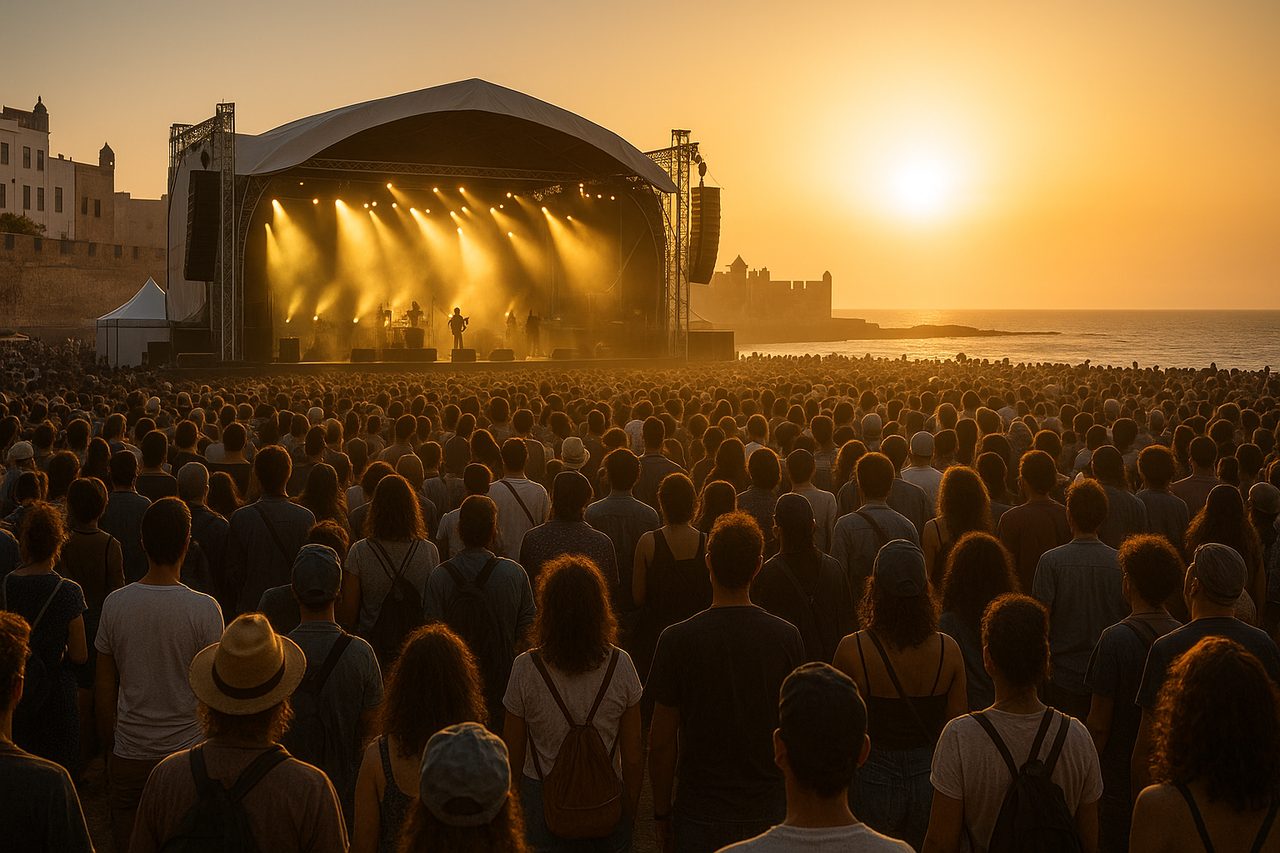
Four annual festivals draw international audiences and reliably deliver top-tier programming:
Fes Festival of World Sacred Music (late May / early June, since 1994). Sacred and classical music from all major traditions — Sufi, Andalusi, Indian raga, Western classical, gospel, Persian dastgah. Held in the Bab Makina courtyard and other Fes venues. Tickets 200-1,500 MAD depending on event. The most prestigious annual cultural event in Morocco.
Gnaoua World Music Festival (Essaouira, June, since 1998). Three days of Gnawa fusion — Gnawa masters perform with jazz, blues, hip-hop, and African musicians from across the diaspora. Completely free, attracts ~500,000 attendees. Book accommodation in Essaouira 4-6 months ahead.
Mawazine — Rhythms of the World (Rabat, June, since 2001). One of Africa’s largest music festivals — 7 stages, ~10 days, headliners include international pop superstars (Rihanna, Pitbull, Bruno Mars, Stormzy in past editions). Most stages are free; VIP packages 500-3,000 MAD.
Marrakech Popular Arts Festival (July). Older and more folkloric than the others — focuses on traditional Moroccan dance, music, and storytelling. Performances in Place el Mechouar near the Royal Palace. Tickets are cheap (50-200 MAD) and the atmosphere is locals-heavy.
For seasonal planning, see Best Time to Visit Morocco — most festivals cluster in June and July, when interior cities are hot but festival nights are cool.
Where to hear live music in Morocco — riads, festivals, plazas
Outside the four big festivals, live music is everywhere if you know where to look:
Riad dinners with live music — many mid-to-upscale riads in Marrakech, Fes, and Essaouira book a 2-3-piece traditional ensemble for the dinner hour. Expect Andalusi or Chaâbi depending on the city. 150-400 MAD per person on top of dinner.
Jemaa el-Fna in Marrakech — the open square has live performers every evening, including Gnawa groups, halqa storytellers with drums, and snake charmers with ghaita. Tip 20-50 MAD for a performance you enjoyed. Photo etiquette: agree on a price before pointing the camera at any performer.
Café concerts in Casablanca — the Boultek music venue and L’Uzine cultural centre regularly host jazz, fusion, and contemporary Moroccan artists. Tickets 50-200 MAD.
Tangier’s Cafés — Tangier has a long jazz history (the Tangier Jazz Festival every September), and venues like Café Hafa and Tangerinn host live acoustic sessions.
Essaouira year-round — outside the Gnaoua festival, Essaouira has multiple Gnawa restaurants and venues with regular ritual music nights. Dar Loubane and Taros are reliable.
Berber music in the Atlas — multi-day trekking trips through Imlil, Ait Bouguemez, or M’Goun valleys often include Berber music nights organized by guesthouses. Often included in private-tour packages — see our Private Morocco Tours guide.
Etiquette — when to record, when to pay, when to just listen
Three rules cover almost every situation:
1. Ask before recording. Both still photos and video. Sacred music (any religious context, Sufi rituals, Gnawa lilas) is the most sensitive — never record without explicit permission. Festival performances are public and recording is generally fine; close-ups of performers’ faces are not.
2. Tip on the spot if you stopped to listen in a public space (Jemaa el-Fna, plazas, café). 20-50 MAD is normal for a song or two. Performers depend on this directly; this isn’t a scam.
3. Dress respectfully at sacred-music venues — same standards as religious settings, shoulders and knees covered. See our Moroccan Culture & Customs guide for the broader etiquette.
Beyond those basics: don’t clap on the off-beats in Andalusi or Gnawa performances unless you’re sure of the rhythm — Moroccan rhythms often work in 6/8 or 12/8 cycles that confuse Western 4/4 instincts. When in doubt, just listen and watch the locals.
Frequently asked questions
What is Moroccan music called?
Moroccan music spans several named traditions — the major ones are Gnawa (UNESCO-inscribed ritual trance music), Andalusi (classical orchestral music brought from Granada in 1492), Chaâbi (popular wedding/party music), Malhoun (sung classical poetry), and Raï (cross-border Algerian-Moroccan genre). Modern Moroccan pop and hip-hop are also major in cities.
What is Gnawa music?
Gnawa is a ritual trance music tradition with Sub-Saharan African roots, brought to Morocco by enslaved people from Mali, Senegal, and the Sahel from the 16th century onwards. It uses the guembri (3-string bass lute), qraqeb (iron castanets), and call-and-response vocals. Originally performed in lila ceremonies (all-night spiritual healing rituals). UNESCO inscribed it on the Intangible Cultural Heritage list in 2019. Best heard live at the Gnaoua World Music Festival in Essaouira each June.
What are traditional Moroccan music instruments?
The core kit: oud (11-string lute), bendir (frame drum), qraqeb (iron castanets, signature of Gnawa), guembri (3-string bass lute, also Gnawa), ghaita (double-reed oboe), riq (tambourine), kamanja (violin held vertically), kanun (78-string zither), tar (frame drum). Modern chaâbi and pop add synthesizers and electric instruments.
Where can I hear Gnawa music in Morocco?
Best venues: Essaouira (riad dinners, dedicated Gnawa restaurants, the Gnaoua Festival every June), Marrakech (Jemaa el-Fna nightly performers, private riad shows), and Casablanca/Rabat at major festivals like Mawazine. The Gnaoua World Music Festival in Essaouira is the unmissable global flagship — free, three days, attracts 500,000+ attendees annually.
When is the Fes Festival of Sacred Music?
Late May or early June each year, running since 1994. Held in the Bab Makina courtyard and other Fes venues. Tickets 200-1,500 MAD depending on the event. Features Sufi, Andalusi, Indian raga, Western classical, gospel, and Persian dastgah programs. Book accommodation 3-6 months ahead.
Is gnawa music religious?
Partly. Traditional Gnawa is performed in lila ceremonies — all-night spiritual healing rituals with origins in Sufi mysticism. In that context it’s sacred and trance-inducing. However, festival and concert performances are secular and public — both forms are legitimate, but recording etiquette differs. Always ask before filming any Gnawa performance, especially in a ritual setting.
Sources
- UNESCO Intangible Cultural Heritage — Gnawa inscription (2019), couscous (2020), argan oil (2014), falconry (2010)
- Ministry of Culture, Morocco — official festival programming and cultural heritage records
- Fes Festival of World Sacred Music — official programming archive (fesfestival.com)
- Gnaoua World Music Festival — official archive (festival-gnaoua.net)
- Mawazine — Rhythms of the World — annual programming and attendance figures
