If you’re trying to decide whether to rent a car in Morocco or hire a driver, this guide gives you the honest answer. We cover the legal basics, what the roads actually feel like, what the police will ask you, and the small habits that prevent 90% of tourist incidents. By the end you’ll know whether driving here is worth the saved cost — or whether to spend it on a private tour instead.
Should you drive yourself in Morocco — or hire a driver?
For confident drivers used to European traffic, a rental car gives you flexibility no tour can match — you stop where you want, you reroute on a whim, you spend an hour in a village nobody else visits. The autoroute system between Tangier-Casablanca-Marrakech-Agadir is excellent, signage is in Arabic and French, and fuel is cheap. A 2-week self-drive trip is genuinely a great way to see Morocco.
For everyone else — first-timers, anyone uncomfortable with chaotic urban traffic, or anyone whose plan involves the Sahara — hire a driver instead. The Atlas roads to Merzouga are 8-9 hour drives on narrow mountain passes; doing them while jet-lagged is no fun. Inside Marrakech and Fes medinas, you can’t drive anyway. And the cost difference is smaller than you’d expect once you add fuel + insurance + tolls + parking + lost-time stress. See our Private Morocco Tours guide for the alternative.
The middle ground: rent for the coastal-and-imperial-city segments, hire a guide-and-driver for the Sahara loop. This is what most experienced repeat visitors do.
The basics: side of the road, licenses, documents you need
Side of the road: Morocco drives on the right (passengers sit on the left, like the EU and US). Roundabout flow is counter-clockwise.
License: Your foreign driver’s license is valid in Morocco for 90 days from entry. The official rule is technically that an International Driving Permit (IDP) is “recommended” — in practice, rental agencies and police accept EU, UK, US, Canadian, and Australian licenses without an IDP. Get one anyway if you have time — it costs $20 in most countries, takes 10 minutes to apply for, and removes any argument at a checkpoint.
Documents you must have in the car at all times:
- Passport (or a clear photocopy in a safe place)
- Driver’s license (and IDP if you have one)
- Vehicle registration (carte grise) — the rental agency provides this; check before driving off
- Rental contract (or vehicle ownership if borrowed)
- Insurance certificate (assurance auto) — mandatory; rental agencies include it but ALWAYS verify coverage limits
Seatbelts are mandatory front AND back. This is the most common ticket reason for tourists — especially for passengers in the back seat who forget. Always belt up before pulling away.
Children must use age-appropriate car seats. Rental agencies provide them but you must request in advance.
Renting a car in Morocco — what to look for and what to avoid
The major international brands — Hertz, Avis, Europcar, Sixt, Budget — all operate at Casablanca (CMN), Marrakech (RAK), and Agadir (AGA) airports. Daily rates run from €25-40 for an economy car, €45-70 for a mid-size, €80-150 for a 4×4 or SUV. Local Moroccan agencies (Medloc, Auto Maroc) are often 20-30% cheaper but quality varies.
Always check before driving away:
- All four tyres including the spare — including pressure and tread depth
- Visible damage photographed on your phone with timestamps
- Fuel level (most rentals are full-to-full)
- Lights, indicators, wipers, AC all functional
- The actual contract matches what you booked — agencies sometimes try to upgrade you without permission then charge for it
Insurance is the biggest single tourist pain point. The basic responsabilité civile (third-party liability) is mandatory and included. CDW (Collision Damage Waiver) is what protects YOU and is what determines your real liability after an incident. Read the deductible (often €600-1,500) carefully. Topping up to “full” coverage with the rental agency costs €10-15/day; using a separate credit-card travel-insurance benefit is often equivalent but you must call your insurer to confirm Morocco coverage.
Things to avoid: picking up rentals from non-airport offices in city centers (often involves arrival hassle), paying cash for upgrades (no audit trail), and anyone offering “informal” rentals through your hotel (no real insurance + no roadside assistance).
Speed limits, road quality, and what the highways are really like
The official speed limits:
| Road type | Limit |
|---|---|
| Autoroute (toll highway) | 120 km/h |
| National highway (RN) | 100 km/h |
| Regional road (RR) | 80 km/h |
| Urban area | 60 km/h |
| Residential / school zone | 40 km/h |
The autoroute network is run by ADM (Autoroutes du Maroc) and is excellent — 1,800+ km of multilane highway connecting Tangier → Rabat → Casablanca → Marrakech → Agadir, with side branches to Fes/Meknes and Oujda. Pavement quality matches France’s. Tolls are cheap by European standards — Casablanca → Marrakech is ~70 MAD ($7) one-way, Casa → Tangier ~120 MAD ($12). Pay cash or with EU contactless cards at toll booths.
National highways (RN-routes) are mostly two-lane, often well-paved but slower because they pass through every town and village. Expect to slow down for unmarked speed bumps in villages, donkey carts in rural sections, and the occasional unmarked detour.
Mountain roads to the Atlas and Sahara are narrow, winding, and often have no guardrails. Drive them in daylight only. Average speed on Marrakech-Merzouga or Fes-Merzouga is 50-60 km/h despite the posted limits — the maps lie about timing.
Radar enforcement is heavy on autoroutes (every 30-50 km) and at the entries to towns on national roads. Most tourists use Waze in Morocco — it shows mobile radar locations crowdsourced in real time, which can save you 700+ MAD in fines.
Police checkpoints, fines, and what to do if you’re stopped
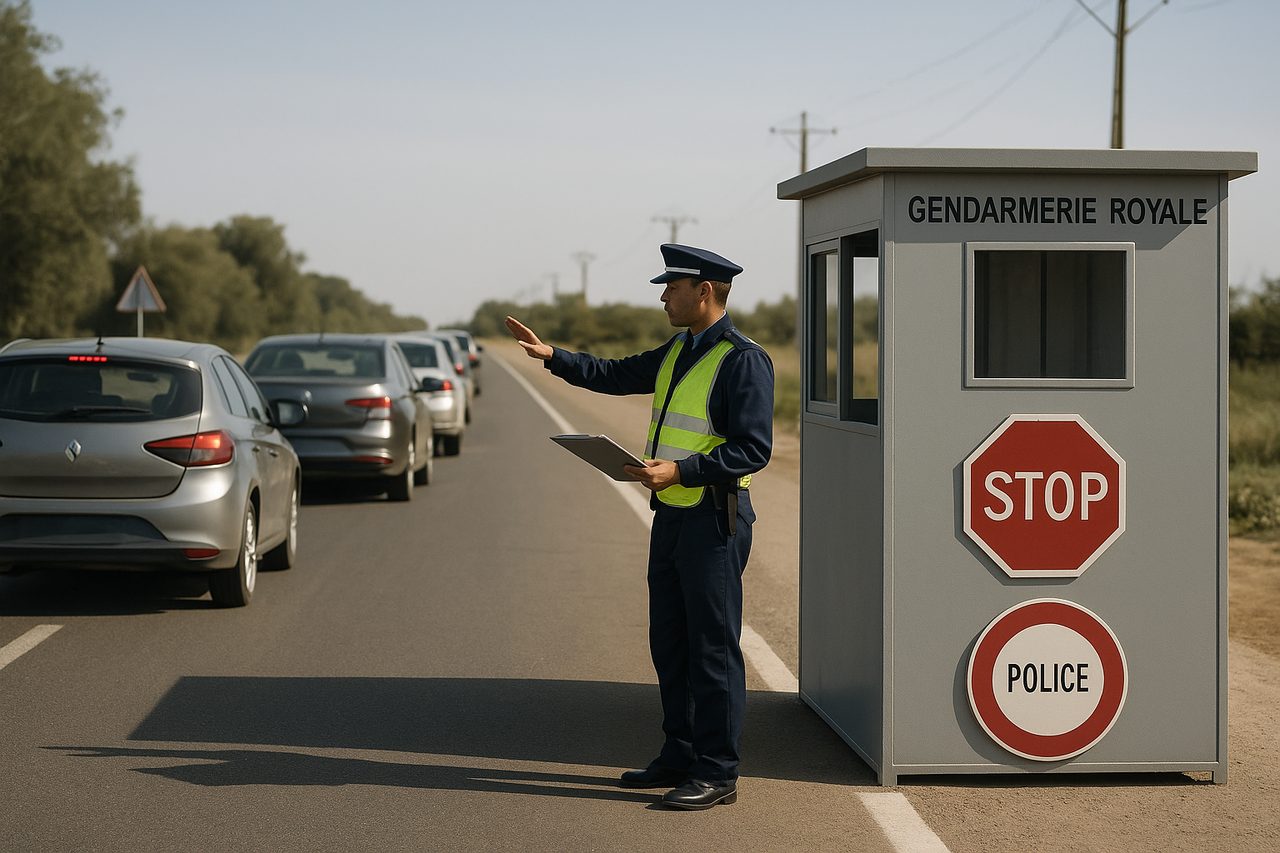
You will pass through police or gendarmerie checkpoints. They are everywhere — at city entrances, on highways, at major roundabouts, and especially at night. Most stops are routine: 30 seconds, document check, wave through.
At a checkpoint:
- Slow down well before reaching the officer — they wave their hand low to ask you to stop, or high to wave you past
- Pull over to the right safely even before the officer’s position
- Have your passport, license, vehicle registration, and rental contract ready
- Be polite, brief, don’t argue, don’t volunteer information
- Don’t touch your phone during the stop — focus on the officer
Fines you might receive:
| Infraction | Typical fine (MAD) | USD equivalent |
|---|---|---|
| Speeding (minor) | 300-500 | $30-50 |
| Running an amber light | 700 | $70 |
| No seatbelt (front or back) | 400 | $40 |
| Phone while driving | 400 | $40 |
| Wrong-side parking | 200-400 | $20-40 |
| Major speeding (15+ km/h over) | 1,000-1,500 | $100-150 |
If issued a fine: Ask the reason and the amount; both should be on a paper receipt (récépissé). Always ask for the receipt. If an officer refuses to give one and only wants cash, you’re being asked for a bribe. Politely insist on the receipt, or ask to settle the matter at the nearest police station — most attempted-bribe stops back down at this point.
For the safer / wider context on what not to do at a checkpoint, see our Is Morocco Safe? section on police interactions.
Parking in Morocco — the “guardian” system and city-by-city rules
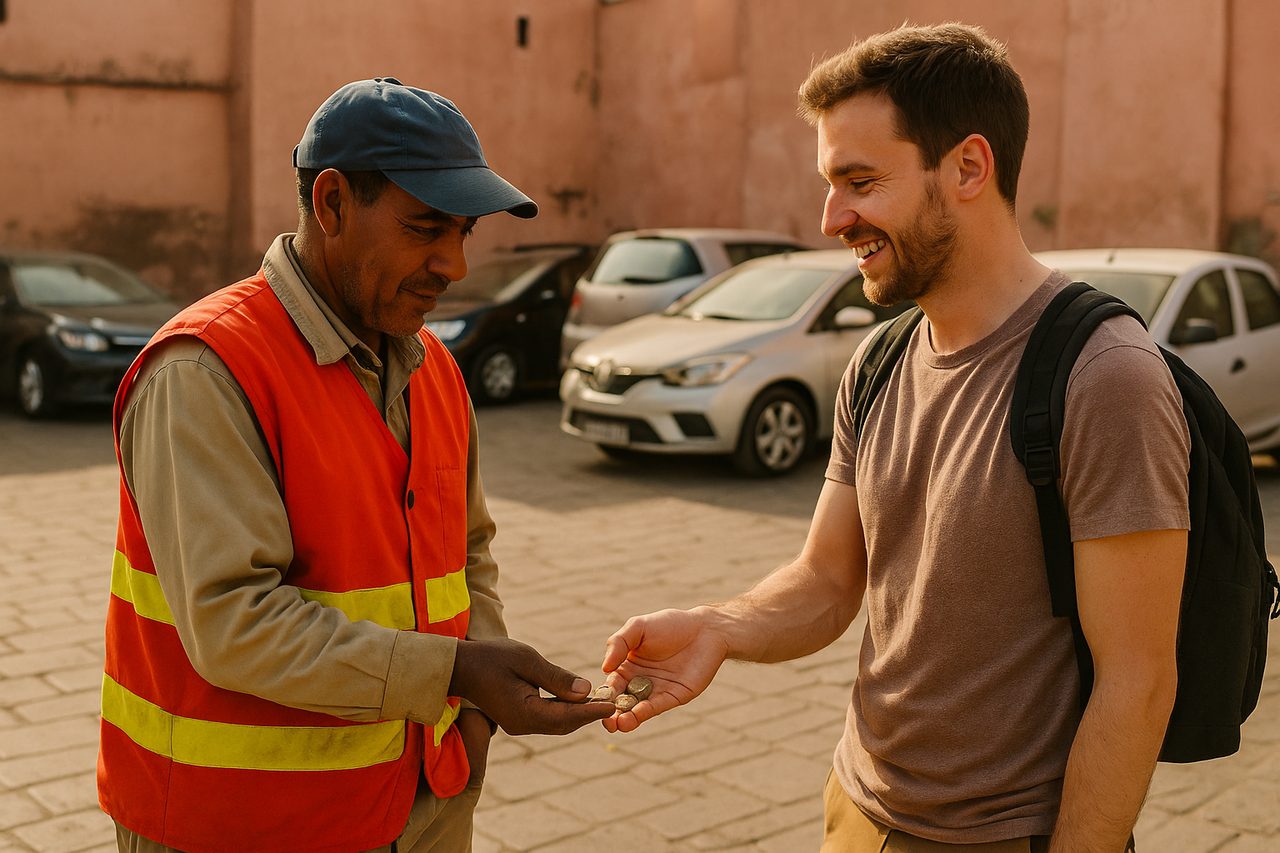
This is the thing that surprises every first-time visitor: almost every street parking spot in a Moroccan city has an informal attendant — the gardien. They wear bright vests (often red, blue, or yellow). They appear from nowhere as you arrive, guide you into the spot, and watch your car while you’re away.
The deal:
- 2-3 MAD ($0.30) for a short stop (under 2 hours)
- 5-6 MAD ($0.60) for an evening or a 5-6 hour stay
- 10-20 MAD ($1-2) for an overnight stay or a full day
- Always pay on return, not on arrival — and tip well if they actually helped (manoeuvring, watching luggage)
It’s informal but real — they actually do watch the cars, and if you don’t pay you may find a flat tire or scratch on return. Pay it. It’s $0.50.
Marrakech medina: no street parking inside the walls. Use the official Place de Foucauld or Bab Doukkala lots, 30-50 MAD/day. Walk in from there.
Fes medina: same rule — park outside, walk in. The closest official lot is at Bab Boujloud (Blue Gate).
Casablanca / Rabat / Tangier: street parking with guardian is the norm in centre and along corniches. Mall parking is metered and structured.
Hotel / riad parking: most riads have a parking deal with a nearby lot or guardian. Always ask “y a-t-il un parking?” when booking — clarify if it’s free or paid.
Common road hazards: pedestrians, donkeys, scooters, and night driving
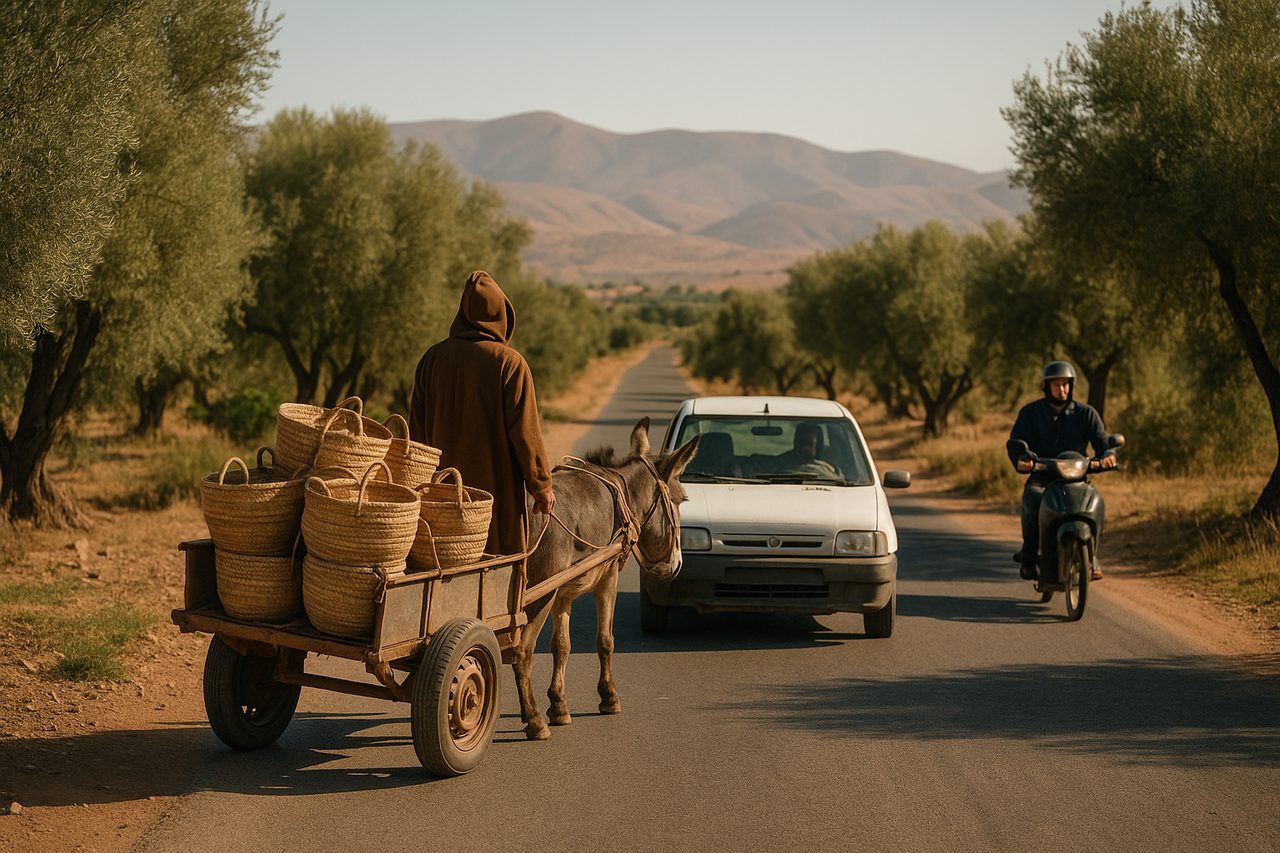
Three categories of hazard that aren’t on European roads but are everywhere here:
1. Pedestrians. Moroccan pedestrians cross wherever, whenever — including on multilane highways. Slow down at every village and town entry. Be especially careful around schools (mornings 7-9, lunch 12-14, end of day 16-18) and at sunset.
2. Donkey carts, animals, and slow vehicles. Mules, donkey carts loaded with hay, sheep crossing, motor-tricycles carrying produce, scooters with three people — all share rural roads. Pass with patience and big margins. Don’t honk at donkey carts; the driver may not be able to easily move and it just rattles the animal.
3. Scooters and informal taxis. In cities, scooters weave between lanes without indicating, and grand taxis (the old Mercedes 240s) make unannounced lane changes to pick up passengers. Mirrors-mirrors-mirrors is the rule.
Night driving outside cities is genuinely dangerous and best avoided:
- Many rural roads have no streetlights and unmarked obstacles (potholes, parked trucks, herds crossing)
- Some drivers drive without lights to “save the battery” or with high-beams permanently on
- Visibility of slow vehicles (donkey carts, bicycles) is near-zero
If you must drive after dark, stick to autoroutes and major national highways, lower your speed by 20 km/h from your daytime pace, and use Waze for hazard warnings.
What to do if something goes wrong
Breakdown on the autoroute: pull onto the right shoulder, turn on hazards, put on a high-visibility vest, set up the triangle behind you, and call 5050 (ADM autoroute assistance). They’ll dispatch a tow within 30-60 minutes. Free for breakdowns; tow charged separately.
Breakdown on a national or rural road: pull off safely, turn on hazards, call 177 (Gendarmerie) for major incidents or your rental agency for a tow. If you’re with a national chain (Hertz/Avis/Europcar), their 24/7 number is on your contract.
Flat tire: pull off safely. Use the spare if comfortable, or call the rental agency to dispatch help. Always check that you have a spare and a jack when picking up the rental.
Out of fuel: pull onto the shoulder safely, turn on hazards, share your location with someone via WhatsApp, and either call the rental agency or wait for a passing local — Moroccans are overwhelmingly helpful to stranded foreigners.
Minor accident: stop, photograph everything (positions, damage on both vehicles, license plates, the other driver’s license and insurance card), exchange contact details, and file a constat amiable (joint accident report) — the rental agency provides a template. Call 177 if there’s any injury or significant damage.
Major accident or injury: call 15 (ambulance) and 177 (Gendarmerie) immediately. Don’t move injured people. Don’t move vehicles until police arrive unless it’s blocking traffic dangerously.
Need someone to help you sort out a roadside problem in real time? Chat with Anass on WhatsApp →
Cost of driving in Morocco — fuel, tolls, parking, insurance
Realistic daily cost breakdown for a self-drive trip in Morocco (per day, for two travelers):
| Item | Cost |
|---|---|
| Rental car (economy, mid-tier) | €25-40 |
| Fuel (~200 km/day, mixed roads) | €15-20 |
| Tolls (if on autoroute) | €5-10 |
| Parking (city + hotel) | €3-8 |
| Insurance top-up (optional, full coverage) | €10-15 |
| Daily total | €60-95 / day |
For comparison, a private driver-and-guide runs $80-150/day budget tier, $150-280 mid-range (see Private Morocco Tours). The cost gap shrinks when you factor in that with a driver you lose zero hours to logistics and have a Morocco-fluent guide handling everything.
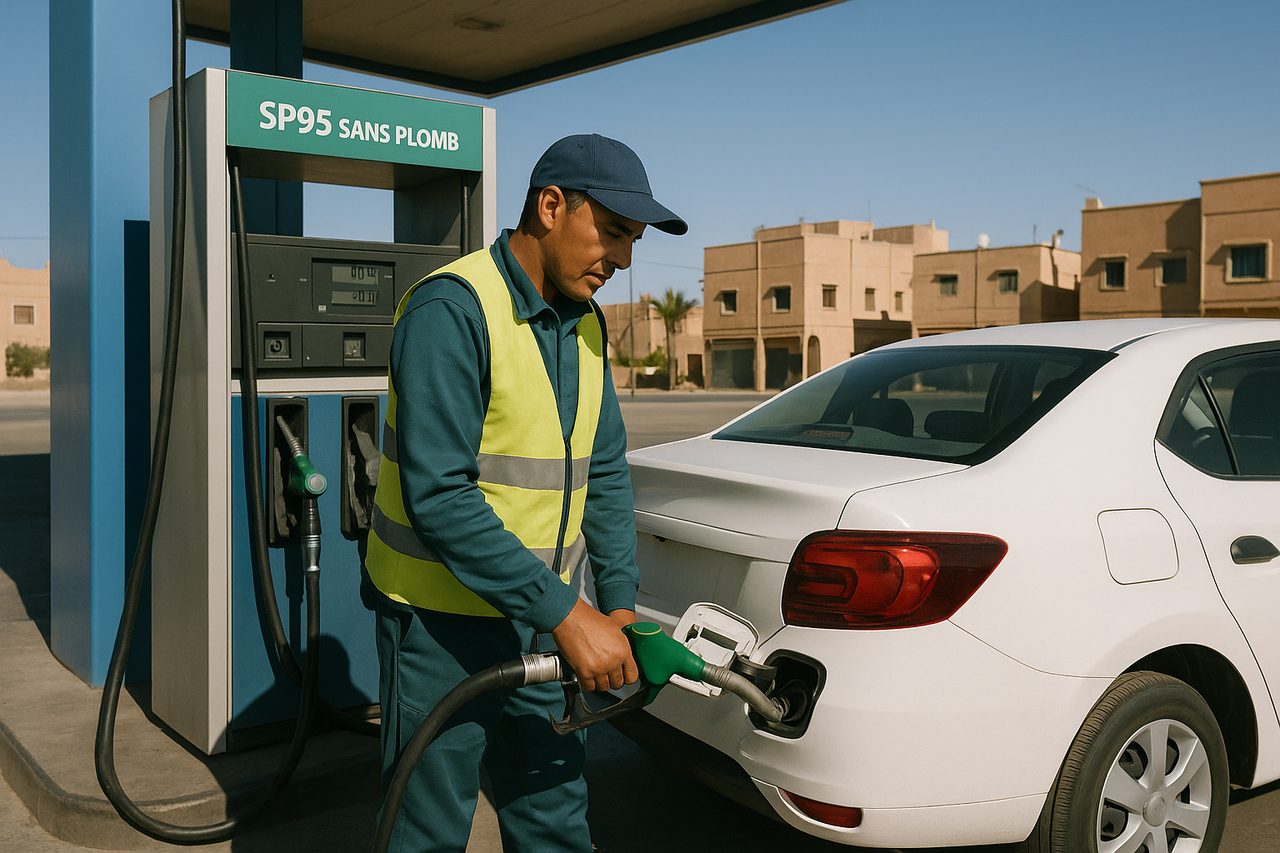
Fuel prices (May 2026): SP95 unleaded ~14-15 MAD/L (€1.40), diesel ~13-14 MAD/L. Filling a typical rental tank costs €40-60. Pump attendants are the norm; tip 5 MAD.
Major rental supply hubs: airport offices at CMN, RAK, AGA work 24/7; city-center offices typically 08:00-19:00. Pickups and drop-offs in different cities (one-way rentals) usually carry a 200-500 MAD surcharge.
Frequently asked questions
Is it safe to drive in Morocco?
Yes, for confident drivers used to European-style traffic. The main highways are excellent, the rules are clear, and police enforcement is consistent. The risks are mostly off-highway: unpredictable pedestrians, animals on rural roads, and chaotic urban traffic in Marrakech and Fes. Avoid driving at night outside major routes. First-time visitors uncomfortable with European traffic should hire a private driver instead.
Do you need an international driving license to drive in Morocco?
Officially, your foreign driver’s license is valid for 90 days from entry, so an International Driving Permit (IDP) is not strictly required. In practice, rental agencies and police accept EU, UK, US, Canadian, and Australian licenses without an IDP. Getting an IDP is still recommended — it’s cheap ($20), takes 10 minutes, and removes any argument at a checkpoint.
What side of the road do they drive on in Morocco?
Right side (driver sits on the left). Same as the EU, US, and Canada — opposite of the UK, Australia, Japan, and India. Roundabouts flow counter-clockwise.
What are the speed limits in Morocco?
120 km/h on autoroutes (toll highways), 100 km/h on national highways, 80 km/h on regional roads, 60 km/h in cities, 40 km/h in residential and school zones. Speed cameras and radar checkpoints are common; using Waze for real-time radar warnings is standard practice.
What do I do at a Moroccan police checkpoint?
Slow down well before the officer, pull over right, have your passport, license, vehicle registration, and rental contract ready. Be polite and brief. If issued a fine, always ask for the official paper receipt (récépissé) — if the officer refuses a receipt and only wants cash, you’re being asked for a bribe. Politely insist on the receipt or offer to settle at the nearest station.
How much does it cost to rent a car in Morocco?
€25-40/day for an economy car, €45-70 for mid-size, €80-150 for a 4×4 or SUV with international brands. Local Moroccan agencies (Medloc, Auto Maroc) run 20-30% cheaper but quality varies. Add €10-15/day for full insurance, ~€5-10 for tolls if using autoroutes, ~€15-20 for fuel — total daily cost ~€60-95 for two travelers.
Sources
- ADM (Autoroutes du Maroc) — official autoroute operator and toll prices (adm.co.ma)
- DGSN (Direction Générale de la Sûreté Nationale) — Moroccan National Police (maroc.ma)
- Ministry of Equipment & Transport — driving license rules and road regulations
- Gendarmerie Royale — rural and highway policing; emergency 177
- Waze — community-sourced radar and traffic alerts; default real-time navigation app in Morocco
