The short version: in Marrakech, Casablanca, Fes, Tangier, or Rabat you can travel comfortably with English. In rural areas, Darija is the unlock. This guide walks through each language tourists actually encounter, gives you 20 phrases that work today, and covers SIM cards and the eSIM setup that lets you reach a local guide on WhatsApp in seconds.
What language do they speak in Morocco?
Morocco’s linguistic map has four working layers. Darija (Moroccan Arabic) is the everyday mother tongue of about 90% of Moroccans — it’s what you’ll hear in taxis, markets, and family conversations. Tamazight — also called Berber or Amazigh — is the indigenous language family, spoken natively by roughly 28% of the population, mostly in the Rif Mountains, the Middle Atlas, and the southern Souss region. French is widely understood — about a third of Moroccans hold a conversation in French — and dominates banking, medicine, university lectures, and government paperwork, a legacy of the 1912–1956 French Protectorate.
English is the youngest entrant: spoken by roughly 14% of Moroccans, but climbing every year because the Ministry of National Education has been moving English up in school curricula since 2020. In Tangier and parts of the northern Rif, Spanish remains conversational among older residents thanks to the former Spanish Protectorate (1912–1956).
“In Tangier, I use Darija with my neighbours, Spanish at the corner shop, and French at the bank. That’s a normal Moroccan day.” — Anass Aouni, Tangier
What is Darija (Moroccan Arabic)?
Darija is the Arabic dialect Moroccans actually speak. It is not the same as Modern Standard Arabic (MSA), which is the formal register used in news broadcasts, the Quran, and government documents. Darija borrows heavily from Tamazight, French, and Spanish — words for “fork” (fershita, from Spanish), “blanket” (kouverta, from French), and many family terms come straight from Berber roots. The grammar drops most vowel endings, simplifies verb conjugations, and switches word order in ways that make Darija largely unintelligible to a speaker of Egyptian or Levantine Arabic without exposure.
For tourists this matters in one practical way: Darija is what gets you smiles. Even a single phrase — shukran (thank you), afak (please) — shifts the tone of a market interaction. Moroccans rarely expect visitors to speak Darija, so the surprise of trying is the whole point. The dialect also carries the country’s history in its loan words: fershita (fork) from Spanish, kouverta (blanket) from French, aman (water) from Tamazight. You learn three languages just by ordering breakfast.
What is Berber (Amazigh), and where is it spoken?
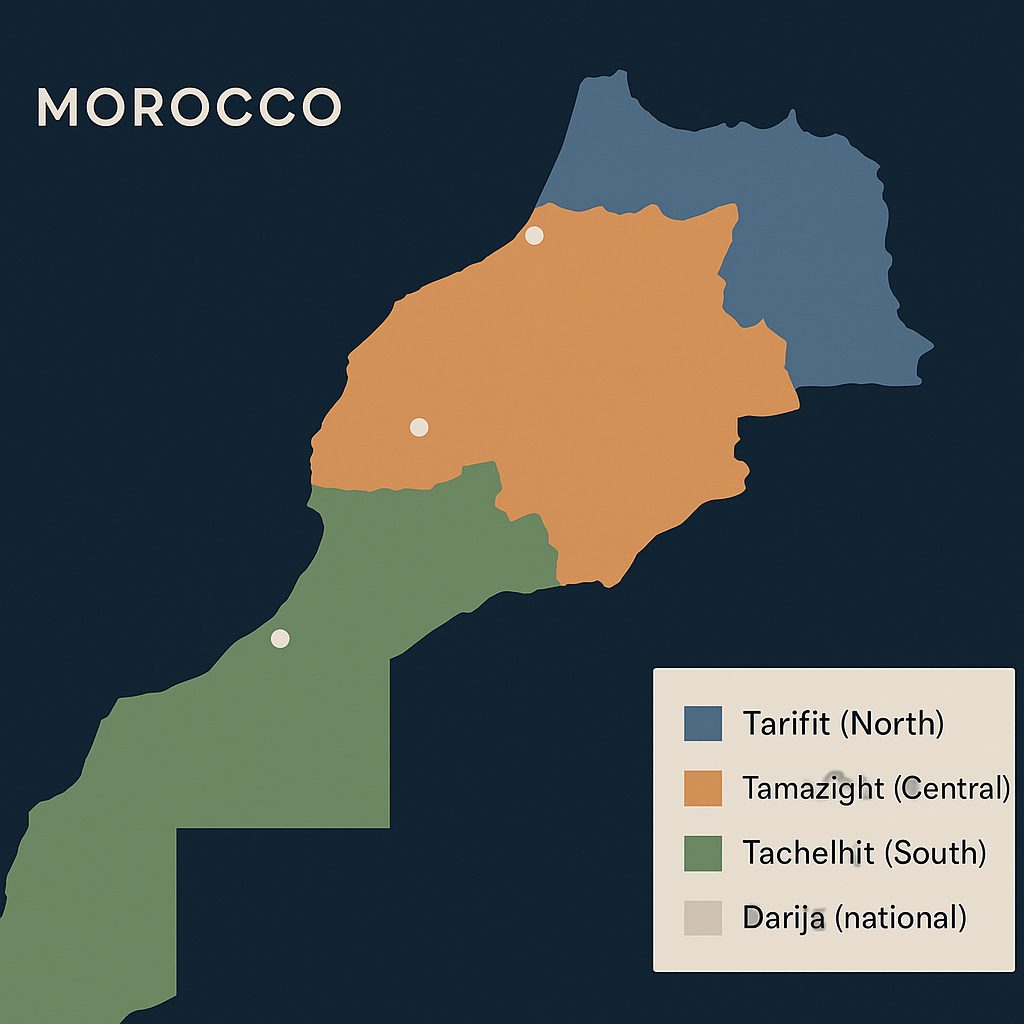
Tamazight is the umbrella name for the Berber language family — the original tongues of North Africa, spoken across Morocco, Algeria, Libya, Tunisia, Mauritania, and Mali for over 3,000 years. Morocco’s 2011 Constitution made Tamazight an official language alongside Arabic, a decision that took effect through Organic Law 26-16 in 2019. You’ll see its alphabet — Tifinagh, with stick-and-circle letterforms — on official road signs, government building plaques, and bank facades nationwide.
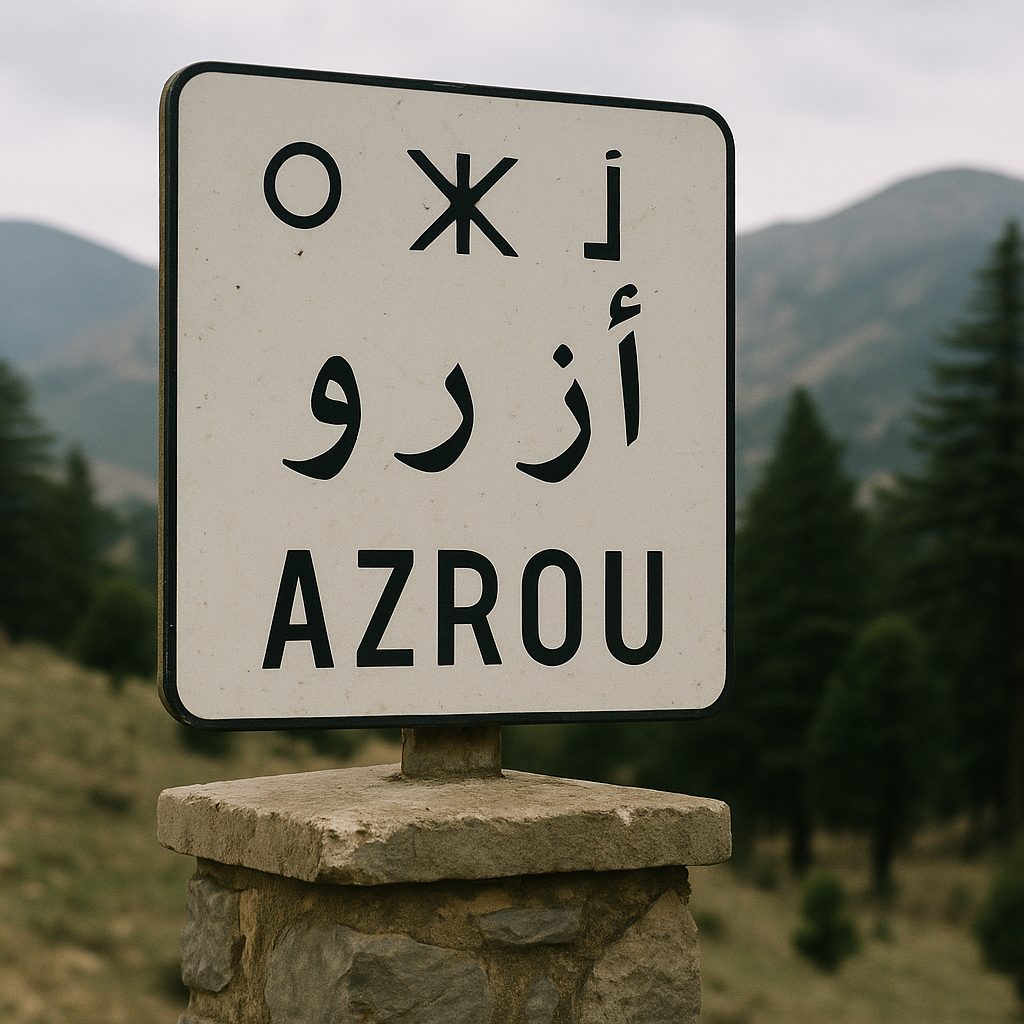
Three Berber varieties dominate inside Morocco: Tarifit in the northern Rif, Tamazight (central) in the Middle Atlas around Azrou and Khenifra, and Tachelhit in the Souss valley and Anti-Atlas south of Agadir. In Aït Benhaddou, Imilchil, the Toudgha Gorge, and most villages off the main highway, Tamazight will be the first language spoken to you. A few phrases — azul (hello), tanmmirt (thank you), manik antgit (how are you) — open doors that Darija alone won’t.
Is French spoken in Morocco?
Yes — French is the de facto second language of public life. Roughly 33% of Moroccans hold a conversation in French, according to the Haut-Commissariat au Plan (HCP), Morocco’s official statistics agency. It’s the working language of banks, hospitals, courts, most university programmes (especially STEM and medicine), and the upper half of the corporate sector. Restaurant menus in Casablanca, Rabat, and Marrakech are routinely written in French first and Arabic second. Major newspapers like Le Matin and L’Économiste publish entirely in French.
This is the French Protectorate (1912–1956) showing through 70 years later. For a traveler, the practical effect is clean: any educated Moroccan you meet professionally — a doctor, a hotel manager, a tour operator, a notary — will be more comfortable in French than in English. If you already speak French, you have a near-native communication channel from day one. One concrete example: at Casablanca’s CHU Ibn Rochd hospital, intake forms and prescription labels are in French. The same is true at most banks (Attijariwafa, Banque Populaire, BMCE), where the menu of every ATM defaults to French.
Where do tourists encounter English?
English is the fastest-growing language in Morocco. In tourist hubs — Marrakech, Fes, Chefchaouen, Essaouira, Tangier, Casablanca — staff at riads, mid-range and upmarket hotels, English-language tour guides, taxi apps, and most restaurant servers under 40 will speak functional English. Mohammed V International Airport in Casablanca (IATA: CMN) handles roughly 10 million passengers a year and Marrakech Menara (RAK) about 6 million, both with full English signage and announcements.
Outside those hubs, English coverage drops quickly. In the Atlas Mountains, the Sahara fringes around Merzouga, the Rif north of Chefchaouen, and the agricultural plains, you’ll switch back to French — or, in many rural villages, to Darija or Tamazight gestures, hand signals, and a phrase app. WhatsApp is the universal communication tool inside Morocco — the country has one of the highest WhatsApp penetration rates in Africa, with roughly 30 million active users out of a population of 38 million. Messaging a hotel or guide before you call them is the local norm. Get a real-time Moroccan phrase translation on WhatsApp → — our travel specialist Anass replies in under a minute.
Where is Spanish still spoken in Morocco?
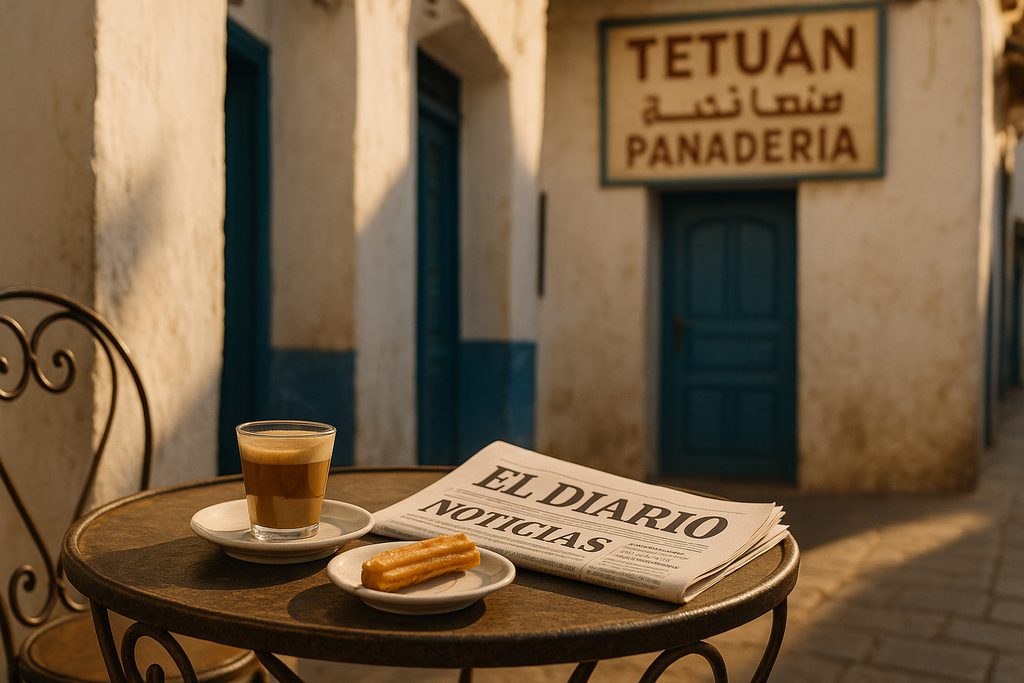
Spanish has a real presence in the north — Tangier, Tetouan, Larache, Asilah, Chefchaouen, and the area around the Rif. Roughly 10% of Moroccans hold a conversation in Spanish, with the percentage climbing sharply above the Rabat line and dropping to near zero south of Casablanca. The historical anchor is the Spanish Protectorate (1912–1956), which administered northern Morocco and the southern Tarfaya strip during the same window the French ran the centre and south.
Today the practical signals are everywhere: TV satellite dishes on Tangier rooftops tuned to Spanish networks, churros con chocolate in Tetouan cafés, Spanish loanwords in northern Darija (plaza, coche, fiesta), and bilingual menus near the Strait of Gibraltar. For Spanish-speaking travelers, the north is the easiest entry into Morocco — many older shopkeepers and taxi drivers in Tangier will switch to Spanish before French if they hear an accent.
20 essential Moroccan phrases for tourists
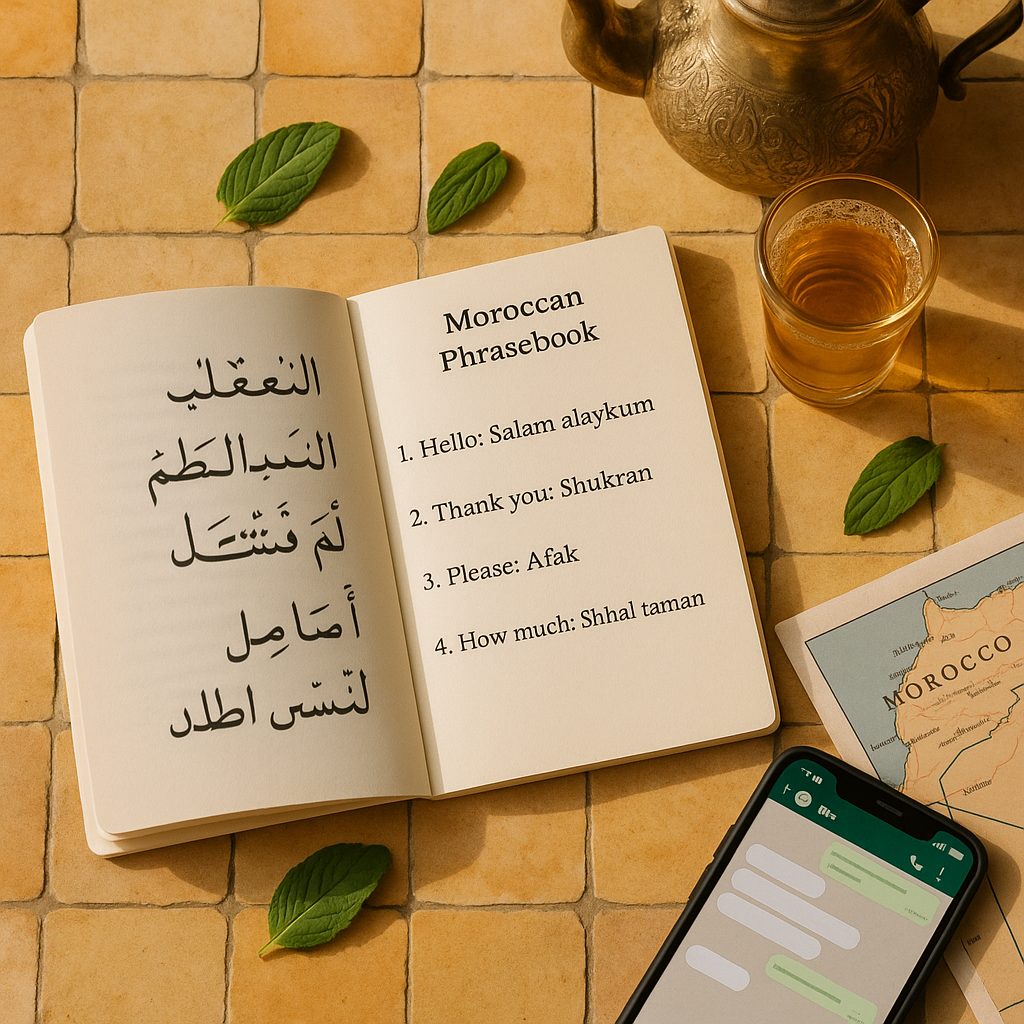
These are the phrases I give every guest in their first hour. Most are Darija; a few are MSA or French where that’s what gets used most. Pronunciation is approximate; ask any Moroccan to correct you — they will, and they’ll enjoy it.
Greetings & courtesy
- Hello / peace be upon you — Salam alaykum (سلام عليكم)
- Reply — Wa alaykum salam (وعليكم السلام)
- Good morning — Sbah lkhir
- Goodbye — B’slama (بسلامة)
- Thank you — Shukran (شكراً)
- Thank you very much — Shukran bezzaf
- You’re welcome — La shukran 3la wajib
- Please — Afak (m.) / Afakum (pl.)
- Excuse me — Smehli
- Yes / No — Eyeh / La
Shopping & money
- How much? — Afak shal taman?
- Too expensive — Ghali bezzaf
- I’ll take it — Nakhdou
- No, thank you — La, shukran
- Where is the bathroom? — Fin l-mirhad?
Help & navigation
- I don’t understand — Ma fhamtsh
- Can you repeat, please? — Afak ma kan fhamchy
- Where is…? — Fin…?
- I need a doctor — Bgheet tbib
- Pharmacy — Saydaliya
- Police — Bolice (emergency: 19 police, 15 ambulance, 112 general)
- Help! — 3awnouni!
“If you only learn three phrases before your trip, make them salam alaykum, shukran, and afak. They cover 80% of friendly exchanges. The other 20% you can do with your phone.” — Anass Aouni
Phones, SIM cards, and eSIM in Morocco
Morocco has three mobile operators, all regulated by the ANRT (Agence Nationale de Réglementation des Télécommunications, anrt.ma). Mobile numbers start with 06 or 07 and all numbers interoperate freely between networks. Total mobile subscriptions in Morocco crossed 52 million in 2024, with smartphone penetration at 91% per ANRT’s annual report.
Here’s how the three networks stack up for tourists:
| Operator | Best for | Coverage | SIM cost | 5 GB | 10 GB |
|---|---|---|---|---|---|
| Maroc Telecom (IAM) | Rural + Sahara fringe | Strongest national; 4G nearly everywhere, 5G in cities since 2024 | 5–20 MAD | 30–50 MAD | 60–100 MAD |
| Orange Maroc | International compatibility | Strong in cities + tourist routes; weaker remote | 5–20 MAD | 40–60 MAD | 80–120 MAD |
| Inwi | Budget urban use | Good urban; thin in rural areas | 5–10 MAD | 25–40 MAD | 50–80 MAD |
Which language should I learn first?
If you have an hour: memorize ten Darija phrases (the greetings, shukran, afak, la shukran, afak shal taman). They unlock smiles in any market and signal effort, which is more valuable than fluency.
If you have a week: add French. Even basic French — numbers, food vocabulary, polite phrases — covers 70% of restaurant, hotel, taxi, and pharmacy interactions outside backpacker zones.
If you’re heading to the High Atlas, the Souss valley, or rural Rif, add two Tamazight greetings — azul and tanmmirt — for the village interactions where Darija is a second language too.
If you’re nervous: don’t be. Every tourist hub in Morocco has English-speaking staff. The 2010s and 2020s saw a generation of Moroccans grow up learning English as their third or fourth language — they’re often eager to practice with you. Smile, gesture, and lean on WhatsApp. You’ll be fine.
A practical rule from my own work: 80% of the language friction tourists report happens at three pinch points — the taxi negotiation, the souk haggle, and the pharmacy counter. The phrases list above is built around exactly those three contexts. Learn five of them in the lounge before landing and you’ve already removed most of the friction.
Frequently asked questions
What language do they speak in Morocco?
Morocco recognizes two official languages: Arabic (used daily as the Darija dialect) and Tamazight (Berber/Amazigh). About 90% of Moroccans speak Darija natively, ~28% speak a Berber variety, ~33% can hold a French conversation, and ~14% speak some English — figures from the Haut-Commissariat au Plan (HCP). Spanish persists in northern Morocco from the former Spanish Protectorate.
What are the languages spoken in Morocco?
The five working languages are Darija (Moroccan Arabic, native to ~90%), Tamazight (Berber, ~28%), French (~33% conversational, dominant in business and government), English (~14%, growing fastest), and Spanish (~10%, concentrated in Tangier, Tetouan, and the northern Rif). Modern Standard Arabic appears in formal media and official documents but is rarely spoken casually.
Is French spoken in Morocco?
Yes. Roughly 33% of Moroccans hold a conversation in French. French dominates banking, healthcare, higher education (especially STEM), the courts, and corporate life — a direct legacy of the 1912–1956 French Protectorate. Restaurant menus in Casablanca, Marrakech, and Rabat are typically printed in French first.
What language they speak in Morocco?
The everyday spoken language in Morocco is Darija (Moroccan Arabic), used by roughly 90% of Moroccans at home and in informal settings. Darija is distinct from Modern Standard Arabic and borrows vocabulary from Berber, French, and Spanish. Tamazight (Berber) is the second native language and is constitutionally official.
Do Moroccans speak English?
Increasingly yes — especially Moroccans under 35 and anyone working in tourism. Hotel staff, riad managers, tour guides, and most servers in Marrakech, Fes, Chefchaouen, Casablanca, and Tangier handle English comfortably. Morocco’s Ministry of National Education has prioritized English in public school curricula since 2020, accelerating the trend.

Sources cited in this guide
- Haut-Commissariat au Plan (HCP) — Morocco official statistics agency; language census data.
- Constitution of the Kingdom of Morocco (2011), Article 5 — official status of Arabic and Tamazight.
- Organic Law 26-16 (2019) — implementation of Tamazight as an official language.
- ANRT (Agence Nationale de Réglementation des Télécommunications) — telecom regulator, market data.
- Maroc Telecom (IAM) — operator coverage and pricing.
- Morocco Ministry of Tourism — international tourist arrivals 2023–2024.